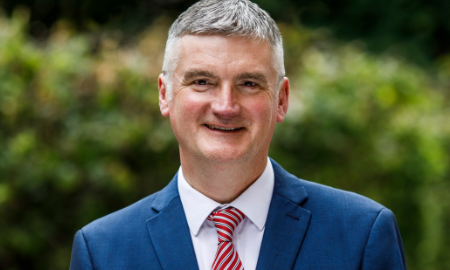

Property lawyer and university lecturer Mark Evans has been inaugurated as the 181st president of the Law Society of England and Wales.
Evans succeeds Richard Atkinson, a criminal law partner at Tuckers in Kent, who led the society’s 200th anniversary commemorations. Evans will be supported by Yorkshire civil litigator Brett Dixon as vice president and Obelisk Support CEO Dana Denis-Smith OBE as deputy vice president.
Evans is only the third Law Society president to come from Wales, and delivered part of his inaugural address in Welsh to solicitors at the society’s annual general meeting held at Chancery Lane in London.
Evans said his primary mission is to support the next generation of solicitors at the start of their careers, regardless of their background. This reflects his previous commitments as vice president to broaden access to the legal profession, especially for those from working-class or underrepresented backgrounds.
Evans has supported the society’s Diversity Access Scheme, having come from a non-traditional background in Wales and training locally to become a solicitor in Wrexham.
Currently a lecturer at the Manchester and Liverpool branches of the University of Law, Evans worked in property and private law for 28 years before moving into vocational education, teaching across the Graduate Diploma in Law (GDP), Legal Practice Course (LPC) and latterly, the Solicitors Qualifying Examination (SQE).
He has been involved with regional and national law societies since 2010, leading the Cheshire and North Wales Law Society as president in 2014 and serving as chair of the Wales Committee. In 2015, he joined the Law Society as a council member for North Wales.
Evans said: “During my presidential year, I look forward to championing the profession in England and Wales and demonstrating to the next generation that there is a place for them in the legal sector,” noting that solicitors should “look to the future with aspiration, confidence and optimism”.
He added: “As president, I will raise awareness of ‘legal deserts’ across England and Wales, where solicitor numbers are declining and communities are struggling to access legal advice. To help address this, I want to highlight non-traditional routes into the profession and help to equip small and medium-sized law firms with the tools they need to ensure access to justice.”
With 33,000 solicitors expected to become solicitors by 2027, and in line with his experience of mentoring and teaching students, Evans said he wants to inspire the next generation by enhancing the quality and standards of legal education and training.
Evans said: “There are still significant challenges for prospective solicitors, particularly for those from disadvantaged backgrounds. I want to ensure young people are aware of the routes they can take to qualify and are confident that their legal education and training prepare them well for their careers.”
He added that aspiring solicitors in Wales should have access to the same opportunities as those in England. He urged the Welsh government to match the offer available to young people in England and fund Level 7 apprenticeships, allowing students to stay and train in Wales.
He welcomed the UK government’s Industrial Strategy, but added that access to technology is needed “so firms of all sizes can access the skilled workforce they need to thrive as the sector continues to move forward”.
Welfare and wellbeing were also key presidential objectives, which include promoting the outcomes of LawCare’s Life in the Law survey, which explores mental health and wellbeing in the legal sector.
The survey’s results showed that nearly 60% of legal professionals reported poor mental wellbeing, while 56% saw themselves leaving their current workplace in five years. Nearly a third (32%) saw themselves leaving the legal sector within the next five years, while 50% of lawyers reported anxiety. Another 32% said they were “not likely” to recommend law as a career.
Evans said long hours, high workloads and client care can have an impact on solicitors, and that the society must continue the conversation about mental health and wellbeing and ensure that it is not stigmatised.
He added: “This year, I aim to support solicitors by holding crucial discussions on wellbeing across the legal sector and by engaging with local law societies, communities and networks to ensure we are united in prioritising our members’ welfare.”
He said he will advocate for solicitor wellbeing, promote greater inclusion within the profession and ensure solicitors receive the support necessary to succeed, while also encouraging greater engagement from ordinary solicitors in the work Chancery Lane does on their behalf and recognising their role in local communities.
Email your news and story ideas to: [email protected]