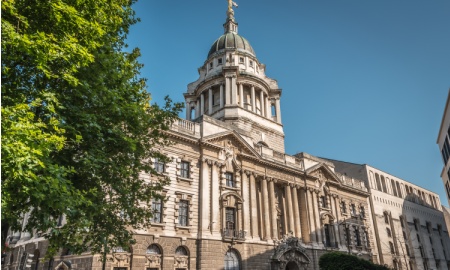

When Sir Brian Leveson delivered his Independent Review of the Criminal Courts, alarm bells could be heard ringing far beyond the Central Criminal Courts at the Old Bailey.
Commissioned by the Lord Chancellor, Shabana Mahmood, Leveson’s report paints a picture of a criminal justice system in England and Wales in danger of collapse if the status quo persists.
At the heart of Leveson’s review lies a shocking backlog: nearly 77,000 Crown Court cases now languish in the queue, with trials slated as far ahead as 2029.
It is a number that erodes the very notion of timely justice for Britain’s corporates. Among the boldest recommendations is a proposal that fraud and bribery cases – if deemed sufficiently serious and complex – could be tried by a judge alone. This, Leveson suggested, would be by election of the defendant and subject to the trial judge’s consent.
It is, as Louise Hodges, partner at Kingsley Napley and chair of the City of London Law Society’s corporate crime and corruption committee, put it, “a very significant recommendation”.
Hodges recognised the bind in which Leveson finds himself, saying he was in “an unenviable position attempting to find capacity in an overstretched and under-resourced criminal justice system that has suffered decades of cuts and underfunding”.
The criminal courts underpin London’s legal services sector – a point crucial for the government’s growth agenda, as the City’s status has been reinforced by strong partner recruitment by major UK and US firms since the Bribery Act, the introduction of Deferred Prosecution Agreements and a slew of high-profile (if not always successful) Serious Fraud Office prosecutions.
Yet the proposal to sideline juries in complex fraud cases is, as Hodges acknowledged, controversial. London’s lawyers are bracing for fierce debate in the coming months, focusing on the criteria for selecting cases eligible for judge-alone trials.
“Much clarity will be needed around the recommendation that cases that were ‘defined by their hidden dishonesty or complexity’ would be tried by a judge alone,” Hodges said.
Professional bodies were quick to respond, and not with quiet acquiescence. The Law Society’s president, Richard Atkinson, said that Leveson’s “root-and-branch review sheds light on how decades of neglect in the criminal justice system mean this vital service is failing the public. Justice delayed is justice denied”.
The Law Society called for a “whole-system approach to deliver lasting change and restore public confidence in access to justice, requiring long-term investment across the entire justice system”.
Atkinson, a senior criminal law partner at Tuckers, acknowledged “the concerns that lengthy cases such as complex fraud trials cause”.
He was unequivocal about the role of the jury: “Juries have a fundamental role in determining serious criminal cases, and the proposals to allow trial by judge alone represent a radical departure from the long-established mode of trial.”
The Bar Council’s response was similarly robust, espousing a firm belief that juries should remain in place for fraud cases – a testament to the deep cultural and institutional roots jury trials have for advocates, especially those in the Criminal Bar Association.
But unanimity is not universal. David Corker, founder and consultant at Corker Binning, voiced a pragmatic counterpoint: “The accused gains a speedy trial and a reasoned judgment at the end. A solution to the travesty of swathes of accused individuals waiting for years for their trial while being held in prison is finally possible.”
Corker notes that both Canada and much of Australia introduced similar reforms more than a decade ago, with many defendants, “when given that choice, have opted for a judge-alone trial”.
Other commentators, such as Lloyd Firth, a partner at WilmerHale, took a different tack. While acknowledging that trial by jury has been “identified as a root cause of backlogs”, he was sceptical that changing the mode of trial addresses the true problem of struggling fraud trials.
Firth pointed to a deeper malaise, asserting the backlogs reflect systemic underfunding, which has declined by more than 22% in real terms since 2010.
Far more pressing than jury trials, he said, are the failures of prosecution disclosure. He added: “The biggest single issue affecting the progress and outcome of fraud trials in England is prosecution disclosure failures. Redrawing the boundaries of when a defendant can elect trial by jury is the answer to a different problem.”
Leveson’s recommendations, far from a panacea, are, in Hodges’s words, “a sticking plaster and not a solution”.
The debate has only just begun, but the message is clear: systemic underfunding is at the root of the crisis.
Unless the UK government invests in the criminal justice system itself, the spectre of cases delayed for years, and justice denied, will continue to haunt the courts from London and beyond. No lawyer, judge or politician should be proud of that.
Email your news and story ideas to: [email protected]