


Generative AI is changing the way law firms deliver legal services. It is accelerating research, drafting and document review. As these efficiencies become more visible, clients may reasonably expect quicker responses, clearer pricing and more tangible evidence of value.
The immediate question for law-firm leaders is often which tools to adopt. The harder question is what AI means for the firm’s people, client relationships and operating model.
David Maister is recognised as a leading authority on the management of professional services firms, with a career spanning Harvard Business School, a body of leading texts, and a global consultancy practice, until his retirement.
Over several decades, he developed a series of frameworks addressing fundamental questions around client relationships, trust, pricing, staffing and the creation of value. Those frameworks still offer today an enduring lens through which to examine the challenges AI is now creating for law firms.
The challenge is not simply to tell lawyers about these ideas. It is to help them apply the framework to a problem they face in practice.
From concepts to decisions
The David Maister’s Frameworks for an AI World course does not ask learners to memorise management theory. It uses Fielding Partners, a fictitious 40-lawyer commercial firm in London, facing recognisable pressures: clients asking why AI efficiencies have not reduced fees, junior lawyers receiving less traditional on-the-job experience, partners debating where to invest and teams trying to protect trusted client relationships while changing delivery.
Learners work through practical situations involving the firm. They consider which Maister framework helps explain the issue, the competing choices and the likely consequences.
As Maister puts it: “Professional is not a label you give yourself – it’s a description you hope others will apply to you.”
In an AI-enabled practice, that judgement is increasingly made through observable behaviour: what lawyers check, what they challenge, how transparent they are about technology and whether they take responsibility for the advice delivered.
A client asks for a fixed fee after discovering that part of the work can be automated. The issue is not only pricing. It raises questions about client value, scope, risk and how the firm explains the judgement that remains necessary.
A practice group wants to use AI to reduce the time junior lawyers spend on research and drafting. The immediate gain may be efficiency. The longer-term question is leverage and development: what work will help juniors build the judgement needed to advise clients and supervise AI responsibly?
A partner wants faster responses and a more automated client experience. The relevant framework is trust. Does the proposed approach improve responsiveness while retaining the personal responsibility, candour and understanding that a client expects from a trusted adviser?
These are not abstract issues. They are decisions firms are making now.
Denken has teamed up with The Global Legal Post to offer readers an exclusive price for 12-month access to all 11 topics in the David Maister Adaptive Learning Library, including Frameworks for an AI World. Click here for more details.
Why adaptive learning matters
A single presentation or policy document can make lawyers aware of these questions. It is less likely to ensure that a junior associate, senior associate and partner can apply the same principles when faced with different decisions.
Adaptive learning provides a common curriculum while changing the route according to each learner’s knowledge and responses. Learners who already understand a concept can move on. Those who need more support receive further explanation, examples and practice before progressing.
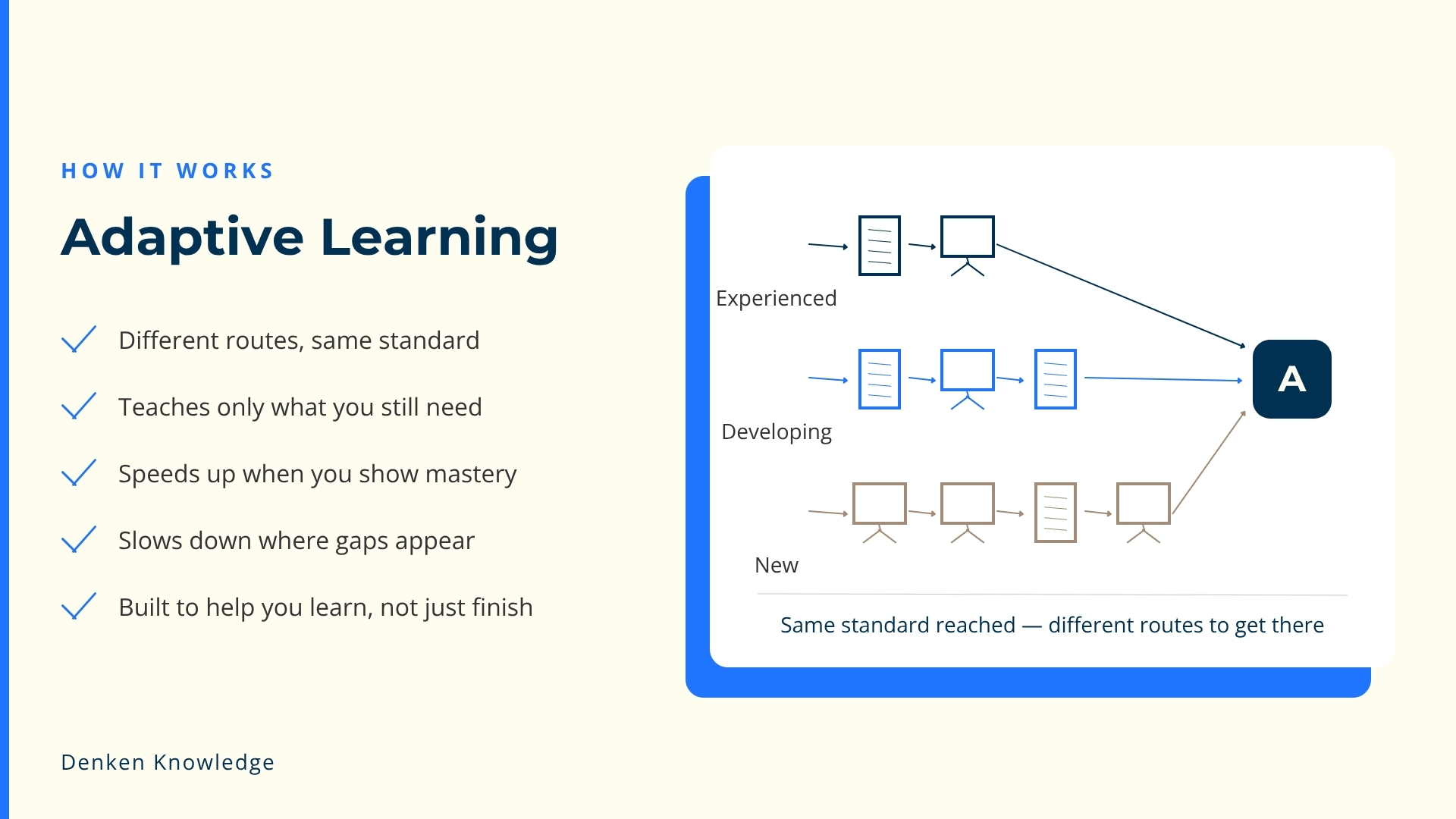
The approach allows a firm to establish a consistent foundation across offices, practice groups and levels of seniority, without treating every learner as though they start from the same point. It also gives leaders better visibility of where knowledge gaps remain.
For junior lawyers, this is particularly important. AI may reduce exposure to routine tasks through which commercial awareness and professional judgement were once acquired gradually. The course creates a structured opportunity to consider client value, leverage, pricing, professional standards and trust in realistic law-firm situations.
For partners and senior lawyers, it creates a disciplined way to test the assumptions behind decisions on staffing, service delivery, investment and client relationships.
Professional responsibility in an AI-enabled firm
AI does not remove responsibility for the advice delivered to a client. Lawyers must still check facts, test reasoning, identify gaps and be clear about what has and has not been verified.
Maister’s work makes the broader point. Professionalism is not simply technical competence. It involves acting in the client’s long-term interest, accepting responsibility for judgement and behaving consistently with the standards a firm promises.
Technology can make a firm faster. It cannot decide whether the firm is using that speed to serve the client better, develop its people or simply increase volume. Those are management choices.
Developed with content approved by David Maister, the course applies his professional services frameworks through adaptive learning. Through Fielding Partners, learners test those frameworks against the practical decisions AI is creating.
As firms redesign how legal work is delivered, they need more than tool training. They need people who can connect technology with client value, commercial judgement and trusted professional behaviour.
Morgan Rigby is chair and Annika Lehmann is managing director of adaptive learning specialist Denken.
Global Legal Post readers can explore the full David Maister series, including this course, and take advantage of a special reader offer through Denken Knowledge's dedicated GLP partnership programme page.
Email your news and story ideas to: [email protected]