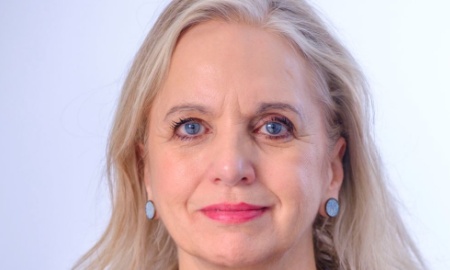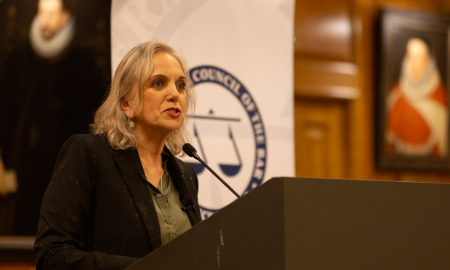

New Bar Council chair Kirsty Brimelow KC set out her key priorities for 2026, including protecting jury trials and legal aid, social mobility, wellbeing at the Bar, fairer allocation of briefs and promoting the Bar’s international work, among others.
Brimelow announced the agenda at her inaugural address as Bar Council chair at Gray’s Inn on Monday night (12 January). She made the preservation of jury trials her first priority, alongside proper funding for the criminal courts and legal aid.
She said: “I am leading the Bar Council’s stance against the government proposals to reduce jury trials,” adding that government proposals restricting jury trials would not reduce deep-seated problems with the criminal courts.
Decrying the backlog of criminal cases, as “built up over years of financial slash and burn of the criminal justice system”, she said the proposed reforms “may further erode trust which hangs by the thread of citizen participation in the criminal courts”.
Her speech also addressed the needs of all publicly-funded legal aid barristers, adding that legal aid should be placed alongside the NHS and education given that it is essential to ensure equality before the law. She emphasised the importance of supporting barristers’ retention and arresting a decline in recruitment.
Praising her predecessor, Barbara Mills KC, she added: “The Bar Council produced a report on the family law Bar in December 2025, setting out that attrition of its barristers from legally aided work is due to increased complexity alongside a severe reduction in legal aid,” while also pledging to continue Mills’ work on preventing violence against women and girls.
Regarding children in the justice system, Brimelow said she had established a working group to consider raising the age of criminal responsibility in England and Wales from 10 years, citing concerns over vulnerability. She also pointed to the lack of data on cases involving abuse and murder due to witchcraft beliefs, which she asked the Sentencing Council to address.
She also addressed more mainstream priorities, including the value of commercial and international arbitration work; the protection of lawyers and judges; the earnings gap among self-employed Bar members; the implementation of Baroness Harman’s recommendations to tackle bullying and harassment; and the promotion of social mobility and disability at the Bar.
On the value of commercial work – arguably a higher priority for past chairs, including commercial silks Nick Vineall KC and Samuel Townend KC – she pledged to support the newly established English Law Promotion Panel, saying she would “promote the work of our barristers both domestically and internationally”.
The Doughty Street silk said she would address green issues, including ecocide, while committing the Bar Council to greater sustainability. She said she would also support barristers working in conflict resolution and rebuilding rule of law and justice systems in countries emerging from conflict, in part inspired by her work in Colombia as a mediator.
Brimelow pressed the government for the UK’s ratification of the Council of Europe’s Convention for the Protection of the Profession of Lawyer, a long-term priority of the Bar’s former international Committee chair, and now Strasbourg judge, Hugh Mercer KC.
Brimelow said: “Conflating barristers with their clients stabs at the heart of the rule of law, and the Bar Council is firm in its support of our barristers.”
Addressing the earnings gap and leading a campaign to improve billing practices were also among her priorities, shared by the Bar’s first all-female leadership team that includes Heidi Stonecliffe KC as vice chair, Lucinda Orr as treasurer and Amelia Clegg as the chair of the Young Barristers’ Committee.
Brimelow revealed she had already met with Law Society president Mark Evans, adding that they would collaborate on the issue. Brimelow added: “Junior barristers and women often don’t bill to reflect the work that they have done, feeling pressured or lacking confidence to bill the full hours that they have worked.”
A Law Society spokesperson confirmed the meeting and noted the society’s commitment to jointly implementing the Women in Law Pledge. “Tackling persistent inequalities requires the legal sector to work collaboratively across solicitors, barristers, chambers, in‑house teams and clients,” which it would do as part of its three‑year equality, diversity and inclusion strategy, the society said.
On bullying and harassment, Brimelow revealed that a new Commissioner for Conduct – a woman – would be announced shortly. She added: “All barristers are entitled to work in a safe environment, and there is no place for bullying and harassment in this profession,” decrying what she sees as an “unacceptable behaviour of a minority at the Bar and on the Bench”.
Social mobility and disability also featured prominently in her speech, noting her background as a state-educated barrister from Chorley, Lancashire.
She said: “Research suggests that a barrister’s socio-economic background continues to have a notable and persistent negative impact on their income. Cultural matching, fit and polish – too often mistaken for merit – should not be determinative at the point of entry to the profession, nor to progress within the profession. Sadly, too often they are.”
The Bar could assist with this by helping children develop stronger oral communication skills, which would be a real opportunity for the Bar to make a difference.
She said: “Advocacy is our profession’s key skill. Over the next 12 months, I will promote the Speak for Success resources we have created for schoolchildren to help them develop core skills in listening, storytelling, persuading and arguing respectfully – skills that we need to navigate life.”
She said: “I will go back to school and, hopefully, inspire a few potential barristers along the way.”
Brimelow concluded with a personal appeal, saying: “I will keep my hand outstretched and offer a ladder down for others,” adding that she would “represent the Bar with courage and kindness”.
Email your news and story ideas to: [email protected]