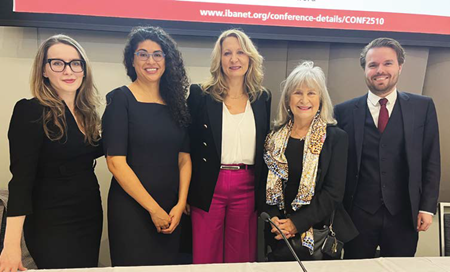

The Trump administration’s attempts to upend the norms of international justice are finding resistance from global institutions, according to panellists at a Wednesday session at the International Bar Association's annual conference, held this year in Toronto.
The session – A conversation about the state of international law under the new Trump era – was chaired by IBA executive director Mark Ellis, who posited that the Trump administration is leading the charge to dismantle the international rules-based legal order established in the aftermath of World War II.
Some panellists were optimistic that global institutions would hold up in the face of this threat.
“The international system, much like the US system, is resilient, and we’re seeing that in a variety of ways,” said Michael Scharf, co-dean of Case Western Reserve University School of Law in the US. “The Trump administration has basically defunded the United Nations unilaterally without Congress, but the UN has responded… and there is strong momentum toward reforms, which have been necessary for years.”
Other institutions are also rising up in ways they haven’t in the past, he said.
“NATO is now being funded more evenly,” Scharf said. “And the Council of Europe has created a new tribunal to prosecute the Russian aggression against Ukraine in the absence of US leadership on that.”
Past events have also shown that international institutions can survive and even thrive following attacks from the US.
Scharf referenced the US withdrawal from the compulsory jurisdiction of the World Court after its ruling on the Nicaragua case in 1986. The result of that wasn’t to kill the World Court, he said, but to double the number of nations that recognised its jurisdiction.
“Sometimes there is an unintended consequence to US attacks against international institutions that end up being very resilient,” he said.
While Trump’s assault on the rule of law domestically has emboldened authoritarians around the world, it has also helped strengthen resolve among other nations, delegates heard.
“If you notice what happened right after the Trump-Putin meeting, the European countries mobilised,” said Irwin Cotler, international chair of the Raoul Wallenberg Centre for Human Rights. “Trump’s threats to annex Canada, either jocular or seriously but repeatedly, has also had an impact on the revitalisation of Canadian identity and purpose.”
Judge Kimberly Prost from the International Criminal Court in the Hague agrees that the Trump administration’s efforts to disrupt the international legal order has had a galvanising effect on other nations.
“From my perspective, living in the city of international peace and justice, I think that there’s reason to be optimistic, and we have to focus on the resilience and not just on the negative effects of what’s happening,” she said.
However, some panellists also worry about the impact this will have elsewhere in the world as the US turns its back on upholding global legal norms.
“The attacks on our judiciary, the hollowing out of our institutions, it’s going to have an effect on the United States, and I frankly think it’s going to have an effect on other countries,” said John Bellinger, a partner at Arnold & Porter and a former US government lawyer.
“We all well know that when the US sneezes, the rest of the world catches a cold, and I worry we’ll start seeing attacks on judges around the world.”
Beth Van Schaak from Stanford’s Center for Human Rights and International Justice, said it will be incumbent on the rest of the international community to continue to find ways to fill the void left by the US, in areas such as the conflict in Ukraine.
“We are hopeful that the Europeans and the justice loving states of the entire globe will step in and find ways to support those efforts, not only because it’s Ukraine, but because it is endemic and systemic of the values of the UN Charter,” Van Schaak added.
“If Russia can do what it did in Ukraine, then any state can do that with respect to their own neighbours. And so we all should be supporting that effort with respect to potential scofflaws in different regions around the world.”
The Global Legal Post is a media partner of the IBA and is publishing the conference’s daily magazine, IBA Daily News, where this article first appeared. Click here for more details. For advertising enquiries, email [email protected]. A copy of today's edition of the IBA Daily News can be found here.
Email your news and story ideas to: [email protected]