
Preface: Restructuring & Insolvency
Law Over Borders Comparative Guide: Restructuring & Insolvency Law Guide
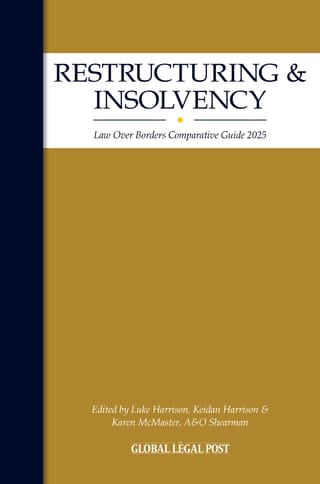 Restructuring & Insolvency Law Guide
Chapters in this guide
20















Restructuring and insolvency law responds to economic cycles, legislative reform, and the evolving needs of businesses and creditors alike. In recent years, the pace of change has accelerated.
Global events — from the COVID-19 pandemic to inflationary pressures, geopolitical instability, and the rise of complex cross-border corporate structures — have placed unprecedented demands on legal frameworks and practitioners. Against this backdrop, the need for clear, comparative, and practical guidance has never been more acute.
This Global Legal Post Law Over Borders Restructuring & Insolvency Guide is designed to meet that need. It gathers together expert contributions from leading law firms across 17 jurisdictions, each offering insight into the legal tools available to distressed companies, their creditors, and other stakeholders. The guide is structured to allow for easy comparison across jurisdictions, with each chapter addressing a consistent set of questions — from the availability of debtor-in-possession regimes and clawback actions, to the treatment of secured creditors, the role of courts and office holders, and the recognition of foreign proceedings.
The jurisdictions covered in this edition reflect both established restructuring centres and emerging markets. From the sophisticated frameworks of the United States, England and Wales, and Singapore, to the evolving regimes of Guyana, Indonesia, and the Czech Republic, the guide captures a wide spectrum of legal traditions and commercial realities. It also highlights the growing influence of international instruments such as the UNCITRAL Model Law on Cross-Border Insolvency and the EU Directive on Preventive Restructuring Frameworks, which are reshaping domestic laws and encouraging greater harmonisation.
We are proud to include contributions from the following firms and jurisdictions:
- Charles Russell Speechlys on Bahrain and the United Arab Emirates.
- Stanbrook Prudhoe on Belize and Guyana.
- Appleby on the Cayman Islands.
- Kačerová advokáti on the Czech Republic.
- A&O Shearman and Keidan Harrison on England and Wales.
- UGGC Avocats on France.
- KebekusPartner Attorneys on Germany.
- JSA Advocates & Solicitors on India.
- NARA Law on Indonesia.
- LEXIA on Italy.
- Brucher, Thieltgen & Partners on Luxembourg.
- Sainz Abogados on Mexico.
- Van Iersel Luchtman on the Netherlands.
- Drew & Napier on Singapore.
- Weil Gotshal & Manges on the United States.
Each chapter reflects the expertise and practical experience of its authors, offering not only technical analysis but also strategic insight into how restructuring law operates in practice. The contributors have generously shared their time and knowledge, and we are deeply grateful for their efforts.
One of the key themes that emerges from this guide is the increasing emphasis on early intervention and business rescue. Many jurisdictions now offer pre-insolvency restructuring tools, cross-class cramdown mechanisms, and debtor-in-possession models. These developments reflect a broader shift in policy: away from liquidation as the default response to financial distress, and towards restructuring as a means of preserving enterprise value, employment, and economic stability.
At the same time, the guide highlights the diversity of approaches across jurisdictions. While some countries offer sophisticated frameworks with extensive judicial oversight and creditor protections, others remain more formalistic or creditor-driven. Understanding these differences — and the practical implications they carry for timing, strategy, and enforcement — is essential for any party involved in a cross-border restructuring.
As co-editors, we have sought to ensure that this guide is both accessible and authoritative. We hope it will serve as a useful reference for practitioners advising on international restructurings, a starting point for comparative legal analysis, and a tool for policymakers and academics seeking to understand the evolving global landscape.
We would also like to thank the editorial and production teams at Global City Media, whose professionalism and attention to detail have been instrumental in bringing this project to publication.
Restructuring and insolvency is a field that demands agility, insight, and collaboration. We hope that the Global Legal Post Law Over Borders Restructuring & Insolvency Guide will support those efforts and contribute to the continued development of effective, fair, and commercially sound restructuring regimes around the world.
The editors wish to thank Nathan Tidd of Keidan Harrison and Meron Haile of A&O Shearman for their assistance with the production of this book.