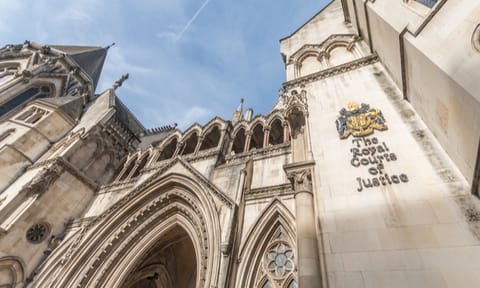

The UK Supreme Court has dismissed two appeals in what is likely to be seen as a definitive case on the enforcement of Russian sanctions.
The appeals were brought by oil tycoon Eugene Shvidler and shipping company Dalston Projects, upholding sanctions imposed under the Russia (Sanctions) (EU Exit) Regulations 2019.
The ruling confirms the legality of the UK government’s actions in response to Russia’s invasion of Ukraine and sets a precedent for the interpretation of proportionality in sanctions cases.
The combined appeals, Shvidler v Secretary of State for Foreign, Commonwealth and Development Affairs and Dalston Projects Ltd and others v Secretary of State for Transport [2025] UKSC 30, mark the first substantive challenge to British sanctions arising from the Ukraine conflict to reach the country’s highest court.
In a majority decision, the Supreme Court dismissed both appeals, with only Lord Leggatt dissenting. Lord Sales and Lady Rose delivered the lead judgment, supported by Lord Reed and Lord Richards. The court found that the designation of Shvidler “was a proportionate measure lawfully issued and maintained by the Foreign Secretary”.
Eugene Shvidler, a British-American businessman and associate of sanctioned oligarch Roman Abramovich, had been targeted by UK sanctions for his alleged association with the Russian state. At the time of designation, his net wealth was estimated by the government to be £1.2bn. Following the sanctions, Shvidler and his family faced significant restrictions, including on his children’s schooling at elite UK private schools.
Shvidler’s legal team, led by Peters & Peters, argued that these measures were “manifestly disproportionate”, violating his rights under the European Convention on Human Rights (ECHR), which protects private and family life, and the peaceful enjoyment of property.
While the Supreme Court accepted that the sanctions interfered with these rights, it concluded that the interference was lawful and justified.
The majority judgment emphasised the policy objectives of the sanctions regime. Lord Sales and Lady Rose noted that sanctions are designed not only to penalise but to deter and influence. “The hope is that it will disincentivise others from associating with the [Russian] government, or encourage them even actively to oppose it in the future,” they said.
Notably, the court clarified the standard that appellate courts should apply when reviewing proportionality. Departing from the Court of Appeal’s reasoning articulated by Singh LJ in the court below, the Supreme Court endorsed a more flexible standard.
It held that appellate courts should conduct a fresh proportionality assessment when the appeal has wide-reaching implications or raises significant social or political issues – as was the case here.
In a powerful and lengthy dissent, Lord Leggatt expressed deep concern about the breadth and consequences of the sanctions.
“Making it a criminal offence for an individual who has done nothing unlawful to deal with his assets without the government’s permission… is a serious invasion of liberty,” Lord Leggatt wrote.
Lord Leggatt added that the courts are “failing in their duty if they simply rubber-stamp assertions made by the executive to justify invading individual liberties without subjecting those assertions to critical scrutiny”.
On proportionality, Leggatt cautioned against what he called an “Orwellian” approach, where individuals are pressured to oppose the Russian regime publicly. “Although I am alone in doing so, I deprecate and would declare unlawful the removal of basic freedoms to which Mr Shvidler should be entitled as a citizen of this country,” he concluded.
Despite the passionate dissent, the judgment stands as a robust affirmation of the UK’s post-Brexit sanctions framework, while attracting comment from City lawyers, academics and journalists alike.
Franz Wild, of the Bureau of Investigative Journalism, noted: “If Shvidler had won, many others who were sanctioned in connection with the Russian invasion of Ukraine [would] probably have followed suit. So the case went right to the heart of how effective the UK’s sanctions regime could be.”
The decision also highlights the trust maintained by sanctioned individuals to review such cases in London’s courts, a trend highlighted by Portland’s research on London litigation trends released earlier this year.
Writing in his blog about the case, Mark Elliot, Professor of Public Law at the University of Cambridge, called Leggatt’s dissent a “Liversidge v Anderson moment”, referring to a famous Second World War case relating to judicial dissent against state powers, adding the dissent “discloses a sharp division of judicial opinion about the proper nature of the judicial role in this context”.
While disagreeing with some of Leggatt’s reasoning, the case “nevertheless represents a welcome return to open discussion at the highest judicial level of contested and profoundly important constitutional questions”.
Corker Binning partner Maia Cohen-Lask said the UK Supreme Court judgment “leaves individuals on the sanctions list facing an even greater hurdle in trying to challenge their designation with the courts”.
Email your news and story ideas to: [email protected]