When Russian forces annexed Crimea back in 2014, Ukrainian born Hanna was just seven years old. Now 18, Hanna has grown up under the long shadow of conflict impacting every aspect of her life.
Speaking at the IBA Human Rights Institute’s showcase at the IBA's annual conference, taking place this week in Denmark, she said: “Always my childhood has been affected by war. Now I live and study in Kyiv. Kyiv is attacked almost every day, both at night and during the day. We hear explosions and go to shelters. Honestly, I’m very tired of living like this.”
Hanna is currently working as a youth advocate and adviser at the Office for Children and Youth under Ukraine’s Ministry of Social Policy. In that role, she has led humanitarian initiatives in areas where the situation is even worse for some children, such as in the city of Oleshky in Ukraine’s Kherson region.
“It is under occupation, around 2000 people are there, including children,” Hanna said. “People do not have enough food, water, electricity and medicine. Some people are forced to eat grass to eat at least something. They cannot simply leave. And when humanitarian help comes, it may be stopped or taken away.”
Denys is 16 and continues to live in a frontline-affected area. Like Hanna, he is also a member of Save the Children Ukraine’s Child Rights Champions and Youth Ambassadors group, while also advocating for meaningful youth participation in decision-making as a member of Ukraine’s National Youth Council.
“A whole generation has grown up with war, and we have learned to adapt,” he told the audience. “We study, we walk, we meet with friends and make our plans. But somewhere in our heads is a small question: ‘What if something happens?’ And we know where there is an air-raid shelter, or what we should do when we hear the air-raid alarm.”
He added: “Young people abroad will also think: ‘What do I want to do this weekend?’ But this question for us is always followed by: ‘Will I stay safe’?”
Hanna and Denys’s stories underscore why the United Nations in June said that violence against children in war reached
devastating new levels last year, raising questions about children’s rights and whether international legal frameworks are
doing enough to protect them.
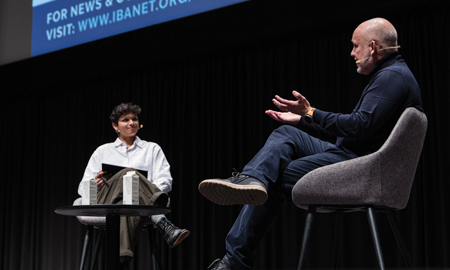
This was the focus of Monday’s session, developed by IBA honorary life president Almudena Arpón de Mendívil Aldama and Save the Children, and moderated by Baroness Helena Kennedy KC, executive director of the IBA Human Rights Institute. The session featured a host of guest speakers who have experienced the impact of war on children, including Hanna and Denys’s first-hand testimony of growing up amid conflict.
The session also heard from speakers on other violations of children’s rights, such as climate change, child marriage and
sexual violence, examining why children’s rights are being increasingly attacked and why perpetrators are seemingly allowed to walk away.
“My dream is to have a world where children’s rights will be protected, and I’m not thinking about a number of generations ahead, let’s do it in three years,” Almudena Arpón de Mendívil Aldama said, adding: “We have the
rules. We have the institutions. We need a further collective push, and we need more accountability in order to make it real.”
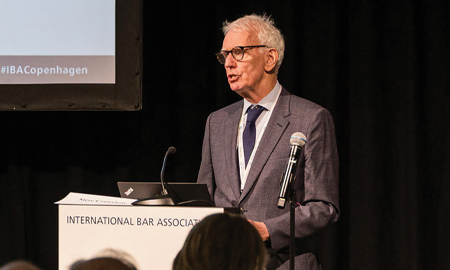
That accountability is a pertinent topic for journalist and human rights activist Steve Crawshaw, whose recent book Prosecuting the Powerful delves into this subject. In a keynote address, Crawshaw noted that the words of Save the Children co-founder Eglantyne Jebb that every war is a war against children are as true now as they were 100 years ago. He said that brazen crimes against children continue, not just in distant conflicts, but here in Europe.
“[Russian] president Vladimir Putin and his children’s commissioner Maria Lvova-Belova felt able just a few years ago to publicly boast about abducting Ukrainian children,” Crawshaw said. “They held an astonishing televised conversation in which they praised the removal of children from their homes, and then their subsequent indoctrination. They presented abductions, clearly illegal under international law, as a humanitarian act.” It was a shameless admission, he added, but it has had consequences.
“Until recently, an international arrest warrant for a world leader would have seemed a political step far too great to take,” said Crawshaw. “In 2023, however, as we all know, the International Criminal Court issued arrest warrants against Putin and against Lvova-Belova under the applicable paragraphs of the Rome Statute. In other words, there is a warrant for the president of a permanent member of the UN Security Council. How unthinkable that would have seemed just a few short years ago." His hope is that Putin’s arrest warrant could open the door to future accountability and send a lesson across the world.
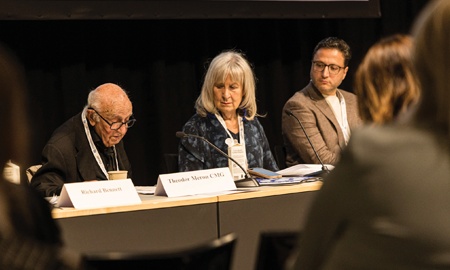
Panel speaker Judge Theodor Meron is a Holocaust survivor and former president of international war crimes tribunals. Meron was an adviser on international humanitarian law to ICC chief prosecutor Karim Khan on the ‘forcible transfers’ of Ukrainian children to Russia, which would be a violation of the Geneva Conventions.
“Repeated efforts to have Russia return the deported Ukrainian children to Ukraine and reunited with their families, incurring efforts so bravely led by Baroness Kennedy, have alas been only partially successful, prolonging the anger and the tragedy of their families,” he said.
Also among the panellists was Syrian doctor Hamza Al-Kateab. He was working in Aleppo during the four years of conflict there, managing the last remaining hospital in the city after nine other hospitals had been bombed by the Russian and Syrian regimes. Parents, he said, would rather treat their sick children at home because they thought it would be safer than being in a hospital. During the siege of Aleppo, he also recounted a story of how a friend from the International Committee of the Red Cross had brought a banana for his daughter Sama through the checkpoint because no fresh fruit was available at that time.
“She had never tasted a banana before,” he said. “We gave her some. She loved it, and later we found her taking the banana peel out of the rubbish and sucking it, trying to get more of that taste. It’s still difficult to talk about that, thinking that I was a doctor trying to keep other people’s children alive, and my own daughter was searching through the rubbish for a taste of a fruit. That is one small memory of what siege does to childhood.”
Shahd Sabir, a child protection specialist who had been working with Save the Children Sudan before the current conflict in the country, became a recipient of humanitarian aid. One day after she was forcibly displaced from Khartoum in April 2023, along with her one-and-a-half-year-old daughter, her daughter became sick.
There was no nearby health centre, so she had to travel to another locality. When she arrived, she saw a Save the Children vehicle and immediately broke down in tears.
“Working for many years as a humanitarian worker, trying to provide humanitarian assistance to conflict-affected children and their families, now I’m not a humanitarian worker anymore, I’m on the end line, I’m displaced myself, seeking medical support for my children,” she recounted. “It was then when I realised that sometimes it’s not only about getting the humanitarian assistance, it’s having a sense of reassurance and the feeling that you’re not facing this alone, there’s always a hope, and there are always people that are here to support you.”
Kennedy, whose work with the IBAHRI has sought to shine a spotlight on some of the world’s most extreme human rights abuses, added that storytelling about the horrors of war and its impact on children was vital for raising awareness.
“We need to take those stories out into the world and let people know the kind of real and terrible suffering and long-term consequences of these experiences for people,” she said.
The Global Legal Post is the official publisher of the IBA Daily News at the IBA Annual Conference in Copenhagen. Follow our coverage throughout the week for the latest news, interviews and insights from the conference. Click here to download a PDF version of Wednesday’s issue.
Email your news and story ideas to: [email protected]