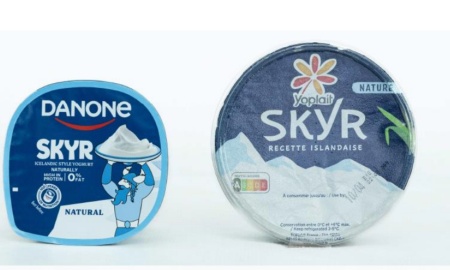

The Irish Court of Appeal has upheld an injunction against global food and drinks company Danone, preventing it from launching a yoghurt product in Ireland that was found to be “confusingly similar” to Yoplait’s existing range.
Mr Justice Max Barrett granted the injunction in May restraining Danone from “passing off” its products as Yoplait’s, pending a trial.
In her judgment on 1 August, Ms Justice Niamh Hyland found that Barrett made no “material error” on a number of counts including evaluation of competing products and identification of the relevant consumer.
She did reach a different view to the trial judge on confusing similarity. However, she added: “I cannot conclude that the threshold of mistake has been reached. It was not entirely irrational for the judge to reach the conclusion that he did.”
The products were two “skyr” yoghurts, which are made using a traditional Icelandic recipe and are low in fat and high in protein.
Yoplait, represented by Browne Jacobsen Ireland, launched its Skyr products in Ireland in September 2022. These products are sold in packaging featuring a blue and white colour scheme with mountain imagery. William Fry represented the appellant Nutricia Ireland Limited, a subsidiary of the Danone group, it launched its Skyr products including yoghurt with blue and white packaging, in a number of countries including France, Belgium and the UK. Danone had intended to launch its Skyr products in Ireland on 6 May this year.
However, following correspondence between the two companies, in April Yoplait issued legal proceedings against Danone saying the two products were “confusingly similar” and lodging a claim of passing off. Danone disputed the claim of passing off and asserted that its packaging is consistent with its established branding and trademarks.
The Irish High Court issued an interim injunction on 2 May that has now been upheld by the appeals court, albeit on modified terms.
Hyland granted Danone’s request to remove the word “confusingly similar” in the order. Danone argued that those words were too vague and that an alleged breach of that order put it at risk of a committal application.
The judge said: “I am conscious that Danone is being denied entry to a market that, on its case, it is fully entitled to enter. If it transpires that it is correct, competition will have been stifled.
She added: “In those circumstances, there is an obligation upon Yoplait to expedite the trial of the action and to make an application to the judge in charge of the commercial list in this respect.”
Finbarr O’Connell, counsel at Dentons in Dublin, said: “The judgment is interesting as the Court of Appeal disagreed with the High Court judge’s impression of the get-up of the products and disagreed that the products were confusingly similar. However, the Court of Appeal could not allow the appeal on this point as it did not conclude that the threshold of mistake had been reached in the initial High Court judge’s subjective assessment of the get-up and similarity of the products. Ultimately, the appeal was rejected as there was no error or injustice in the approach of the High Court judge.”
He added: “In general, global brand companies should be aware of brands that already exist when entering the Irish market. The key lesson in this case is that a brand name or trademark on a new product may not be enough to prevent a competitor with established goodwill obtaining an interlocutory injunction if the new product has an otherwise similar design to the competitor's product.”
Email your news and story ideas to: [email protected]