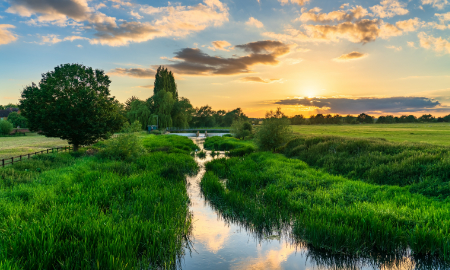

In February 2023, Lewes District Council passed a motion to explore development of Rights of Rivers for the River Ouse, two years later the council passed a motion to support and champion the Rights of the River Ouse Charter: this was the first time an English council had successfully recognised the rights of rivers in a charter (though it certainly wasn’t the first attempt, as early as 2018 Frome Town Council applied to enact a byelaw which proposed granting the Rodden Meadows and River Frome legal personality).
To date around 20 councils and parish councils have passed motions to recognise rights of rivers (including catchment and ecosystems) and trees. Recently Maidstone Borough Council formally adopted a Rights of Nature framework paving the way for it to “embed the principle that nature has an intrinsic right to exist, thrive and evolve across its governance, decision‑making and service delivery”. Most recently, in July 2026, Cambridge City Council recognised the Rights of the River Cam and the residents of Greater Cambridge asked for a permanent voting seat for the Voice of the River on the board of the Greater Cambridge Development Corporation.
The charter development is a uniquely contemporary demonstration of a grass-roots, non-partisan driven approach to the development of custom and practice, or put another way, the emergence of customary law. As we all know, customary law is generally considered to be a body of unwritten rules and practices that have evolved over time, widely adopted – with the potential to be codified.
This not unusual and echoes the ancient beliefs held by many local and indigenous peoples. As Monica Feria-Tinta noted in her book ‘A Barrister for the Earth’, this belief that nature should be respected and its essential processes should not be impaired was also enshrined in the United Nations World Charter for Nature in 1982 (with the UK voting in favour).
Passing the charter is just the first step – albeit one that requires a lot of time and work. Once a council has passed a charter the next step is integrating the rights into the existing patchwork of statutory duties and policies that they work within.
We have our charter, what’s next?
Generally, council motions have recognised the right to flow, to be free from pollution, to sustain their ecosystems, to be fed by and feed sustainable aquifers and to regeneration and restoration. Many of them also include a right for rivers to be represented (or similar concepts of stewardship or guardianship): this right has no parallel in existing environmental law so needs some thought as to how to achieve it.
We set out a number of ideas as to how representation or guardianship might be achieved in our Rights of Rivers Guide. But in practice, we have seen councils appointing Nature Champions and River Champions or nominating councillors to speak at meetings on behalf of nature. We have also seen a number of community groups experimenting with Interspecies Councils (where participants each represent a different species from a river bringing a unique perspective of, for example, a kingfisher).
Once a charter is in place and the rights are recognised, there is a need to move from paper to action to ensure that they are abiding by their motions and also to meet the expectations of constituents who have mandated them to implement rights of nature.
Against a background of local council restructuring and devolution, many councils are now:
· integrating rights into their decision-making processes by amending local plans and climate and nature strategies or creating a framework which overlays decision-making;
· investigating when nature can be considered as a ‘material consideration’ for decision-making on planning;
· reviewing procurement policies and criteria for suppliers to reference rights of nature or rivers; and
· considering many other novel ways to reflect a change of perspective in the consideration of nature in decision-making.
A number of councillors and grassroots local groups have mentioned the importance of ceremony for rights of rivers and nature. Bringing local businesses and people of a community together to celebrate the river, perhaps to pledge to recognise the rights of the river, can be a powerful way to foster community and a love of the river which encourages better personal and business decisions for the river (even if it is not binding and no one will police their actions). The ceremony launching the River Wye Charter is a good example of this.
What does the future hold?
Although councils are recognising that nature has rights, this cannot grant legal rights to rivers or nature.
A private members’ bill currently making its way through the House of Lords (the Nature’s Rights Bill) seeks to enshrine legal rights for nature. The bill, which Baroness Bennett has called the ‘Green Magna Carta’, recently had its second reading in the House of Lords and is now at committee stage.
The idea was seriously debated in the House of Lords garnering some support for legal personhood for nature. One argument was particularly interesting: “His Majesty’s loyal opposition believe that we should never, on any account, risk sidelining the everyday economic realities of UK citizens, or indeed our national security” as it seems to miss the point that our national and food security rely heavily on nature and biodiversity (see the Joint Intelligence Committee’s assessment exploring how global biodiversity loss and the collapse of critical ecosystems could affect the UK’s resilience, security and prosperity).
The bill may not be successful but the constructive debate in the House of Lords shows that it is now on the map and that a new way to navigate the tensions and conflicts between humans and the rest of nature in decision-making can be found.
The authors, Emily Julier, counsel knowledge lawyer, and Yasmin Waljee OBE, international pro bono partner, were part of the team advising the Environmental Law Foundation (ELF) on the Charter for the Rights of the River Ouse at Hogan Lovells Cadwalader. The team at Hogan Lovells Cadwalader also co-wrote the Rights of Rivers Guide: a practical guide for local communities and local authorities to recognise your local rivers’ rights with the Environmental Law Foundation and continues to collaborate with clients in the UK and globally on rights of nature.
Email your news and story ideas to: [email protected]