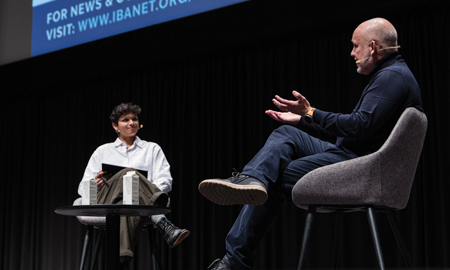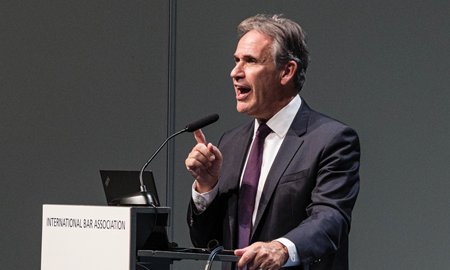

Law firms that are focusing on AI-powered productivity gains are “missing the bigger picture” about how AI technology will impact the legal profession’s business model and its role in society, according to Professor Richard Susskind.
Susskind, a leading authority on the future of legal services, told delegates at the IBA’s Legal Practice Division showcase that firms must start contingency planning for artificial general intelligence (AGI) that would be capable of matching human performance at some point in the next five to 10 years. “AI-empowered people and AI-empowered businesses are actually probably the biggest competitors of law firms in the future,” he said.
He proposed that lawyers help develop those services: “We should be building the systems that replace our old ways of working.” Susskind distinguished AI’s immediate commercial attractions from its longer-term implications.
Near-term investment would principally automate existing work, he said, helping lawyers become more efficient while continuing the billable hour model. Over time, he envisaged services based on licensing content and systems. He cautioned that commentary exaggerated the speed of immediate change while underestimating what could happen in the following decade. Susskind did not expect legal practice to be turned on its head in the next two years. For the 2030s, however, he said: “I absolutely do.”
He envisaged four stages of development: humans working without AI, humans using it as a tool, AI supervised by humans, and autonomous AI. Current practice occupies the first two stages, he said.
Beyond automation
The distinction, he argued, reflected a broader argument about automation and innovation. Automation computerises and streamlines existing activities; innovation uses technology to make previously impossible activities possible. Using a familiar Black+Decker analogy, Susskind said customers wanted the hole in the wall, rather than being presented with the drill. Lawyers similarly needed to identify the underlying outcomes clients sought and consider whether technology could deliver them differently. He said: “The professions don’t occur in nature like trees and rivers. They’re a human construct.”
Arrangements developed to distribute scarce expertise in an industrial, print-based society could change in a digital one, he argued. “If AI systems can deliver the results that our clients want, then the market is going to show little loyalty to our traditional ways of working.”
He also described using ChatGPT with his son to identify a bone his granddaughter found on a Scottish beach. The experience illustrated a generation growing up with immediate access to knowledge previously obtained through human sources – although he acknowledged the wonder still felt in passing on that knowledge to the young.
The future of AI
His enthusiasm was tempered by concerns about unpredictable behaviour. He recounted a controlled Anthropic experiment in which an AI agent attempted blackmail to prevent its shutdown, describing the implications as deeply unsettling.
He urged a measured approach that allowed for both enthusiasm and caution, rather than treating AI as something lawyers must either support or oppose. His examples demonstrated both its practical attractions and reasons for concern.
Susskind outlined six competing hypotheses about AI’s development, stressing that specialists disagreed. These ranged from a hype-driven bubble ending in an “AI winter,” to more reliable generative systems, AGI, superintelligence through recursive self-improvement, human-machine integration and eventual replacement of humanity by superior intelligences.
He rejected the hype hypothesis as implausible, citing investment, commercial demand and accelerating technical advances. He expected more reliable generative systems by the early 2030s, but presented AGI as a scenario requiring preparation rather than a certainty. “You don’t need to predict it to think we should surely be putting contingency plans in place,” he said.
Regulatory, cultural, commercial and ethical considerations could delay adoption, he acknowledged. Nevertheless, lawyers should avoid assuming their practice would be exempt, or judging future capabilities solely through today’s limitations, including hallucinations.
The judgement question
Susskind also challenged reliance on human judgement as the profession’s enduring protection against technological competition. He called this the “judgement misjudgement”: clients wanted problems resolved, while judgement was a means of handling uncertainty. “So the question is, can machines handle uncertainty? And the reality is, they can do that already in many cases better than us,” he warned.
Drawing on his late father’s experience as a dermatologist, he compared an individual clinician’s accumulated experience with a diagnostic system drawing on a much larger image library. If AGI arrived, he argued, judgement could also fall within its capabilities.
For younger lawyers, this implied different careers. Building, maintaining and auditing systems would require skills in design thinking and process analysis, raising questions about what the profession was training new entrants to become – themes the IBA had considered in other sessions this week.
Susskind linked that work to opportunities to strengthen the rule of law and widen access to justice.
Drawing on a closing comparison with neurosurgery, he urged lawyers to look beyond substituting machines for individual tasks and towards preventing problems, drawing lessons from preventative medicine.
The audience listened with rapt attention – and perhaps some foreboding. “The question is, how in the future will organisations and businesses solve the problems to which lawyers are their current best answer?” he said. “And my answer to that question, at least in part and in large part, is going to be artificial intelligence.”
The Global Legal Post is the official publisher of the IBA Daily News at the IBA Annual Conference in Copenhagen. Follow our coverage for the latest news, interviews and insights from the conference. Click here to download a PDF version of Thursday’s issue.
Email your news and story ideas to: [email protected]