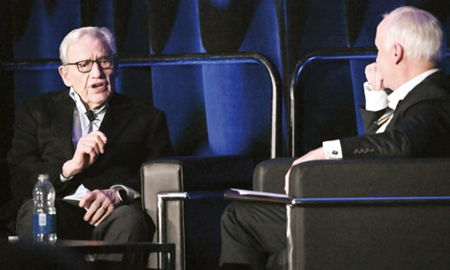
In a far-ranging conversation with International Bar Association (IBA) executive director Mark Ellis, two-time Pulitzer Prize-winning journalist Bob Woodward accused US President Donald Trump of overseeing an unprecedented abuse of power and challenged the news media to “raise their game” reporting the news fairly and accurately.
In an hour and a half session at the IBA's annual conference, held this year in Toronto, Woodward discussed presidential power and accountability, offered lessons from Watergate and spoke about the news media’s “loss of integrity”.
“What Donald Trump has done is shredded the rule of law,” Woodward said. “Under the constitution of the United States, the president has real power and Trump has seized it. He is an authoritarian leader within a democracy.”
Woodward interviewed Trump in 2016 and asked him his definition of power. “Trump told me that real power is fear,” Woodward explained. “He is using that fear now to extend the power of the presidency to an extent we have never seen before. The presidency has become a money-making opportunity for himself and his family. The founding fathers of our constitution would shudder to see what has happened and the absolute subversion of the Republican party by Trump.”
As an example, Woodward recounted that during 20 interviews with Trump in 2020, he learned that the president was warned by Robert O’Brien, his national security advisor, that the coronavirus would be the biggest threat to his presidency, was expected to kill at least 650,000 people and was going to be like the Spanish flu of 1918.
“Trump’s response was to say that it was going to go away,” Woodward said. “When you look at what Trump did, if he would have shared the warning with the public... It was a moral felony on his part.”
Ellis asked Woodward to compare and contrast President Richard Nixon’s crimes during Watergate to issues in the Trump presidencies.
Woodward said there was a significant difference in these situations. “What Nixon did was criminal and he resigned when his own party turned against him,” he said, adding that when Nixon went to Republican leaders to ask whether he could survive impeachment proceedings with the required two-thirds, or 67 votes, in the Senate, Republican Senator Barry Goldwater told him: “Mr. President, you do not have five votes and one of them is not mine.” The next day Nixon announced he was resigning.
He added: “The difference here was individuals making assessments and not concealing them. I know there are lots of Republicans who do not like Trump but will not speak on the record. These are profiles in a stunning lack of courage.”
When Ellis asked about the Democrats and their role, Woodward responded: “Trump has rendered the Democratic party weak, and they have rendered themselves weak. We will see who, if anyone, comes out as the Democratic leader. It stuns me, to be perfectly honest, that there is not someone in the Democratic party who has risen to the occasion.”
As the conversation shifted to news coverage of the presidency and the rise of so-called ‘fake news’, Woodward said the media is experiencing a difficult time. “A great deal has shifted and I think we have done it to ourselves
by not being rigorous,” he said.
He added that the news media has “relaxed” its standards and relies too often on what he termed “ambiguous attribution” rather than being rigorous in its reporting, relying on first-hand witnesses and documents to ensure
journalistic integrity.
“In the media business, we need to go down the path of self-examination,” he said. “We need to source information that is as good as the courtroom. If we don’t have that, don’t publish, don’t broadcast.”
When asked by an audience member about what can be done about this given that Trump was democratically elected, Woodward responded: “Correct what we can in the media. It sounds simple but let’s rely on
sources with first-hand and or documentary information.”
Woodward then pulled a small card out of his pocket.
“There is a little card I carry around and it’s very worn,” he said. “The first word on it is ‘risk’. Because of Trump, we are living in risk and the question I ask is, when does it become an intolerable risk? I think it’s intolerable now and the question is, what is the road back and who is going to lead us on it?”
Woodward gained international attention when he and Carl Bernstein uncovered the Watergate scandal in 1973. Since then, he has worked to shine a light on the inner workings of secret government. He has won nearly every American journalism award and two Pulitzer Prizes. He is currently an associate editor of the Washington Post, where he has worked since 1971.
The Global Legal Post is a media partner of the IBA and is publishing the conference’s daily magazine, IBA Daily News, where this article first appeared. Click here for more details. For advertising enquiries, email [email protected]. A copy of today's edition of the IBA Daily News can be found here.
Email your news and story ideas to: [email protected]