
When City of London stalwart Ashurst announced earlier this week that it had agreed to merge with US firm Perkins Coie, it is fair to say the market wasn’t taken completely by surprise.
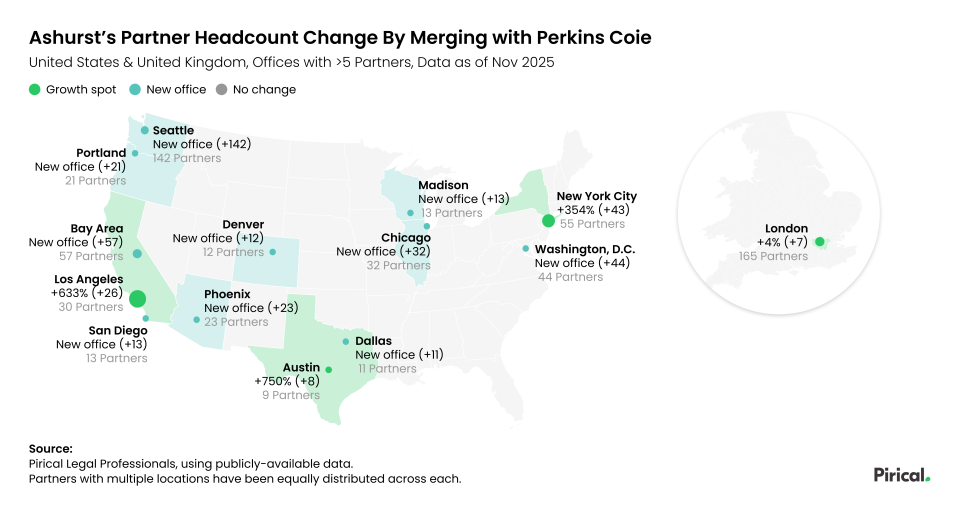
The proposed tie-up will create a top 20 global firm and has an undeniable logic, giving Ashurst a very sizeable presence in the lucrative US market and Perkins Coie a large international footprint (see map below, originally published in a blog by Pirical).
It also comes off the back of two other large transatlantic mergers that created A&O Shearman in May last year and HSF Kramer this summer.
Ashurst Perkins Coie, as the combined firm will be known, will boast revenue of $2.7bn and hold the promise of providing the firm with momentum to improve its position in a competitive market.
“This could be a transformative merger if they get it right, in terms of market profile, impact and being able to go up a level with the clients they pursue,” said David Morley, former legacy Allen & Overy senior partner and co-founder of the consultancy Dejonghe & Morley.
“It’s a scale game now – $1bn is quite small for a global firm, you need to be able to invest in top talent and AI to really differentiate yourself.”
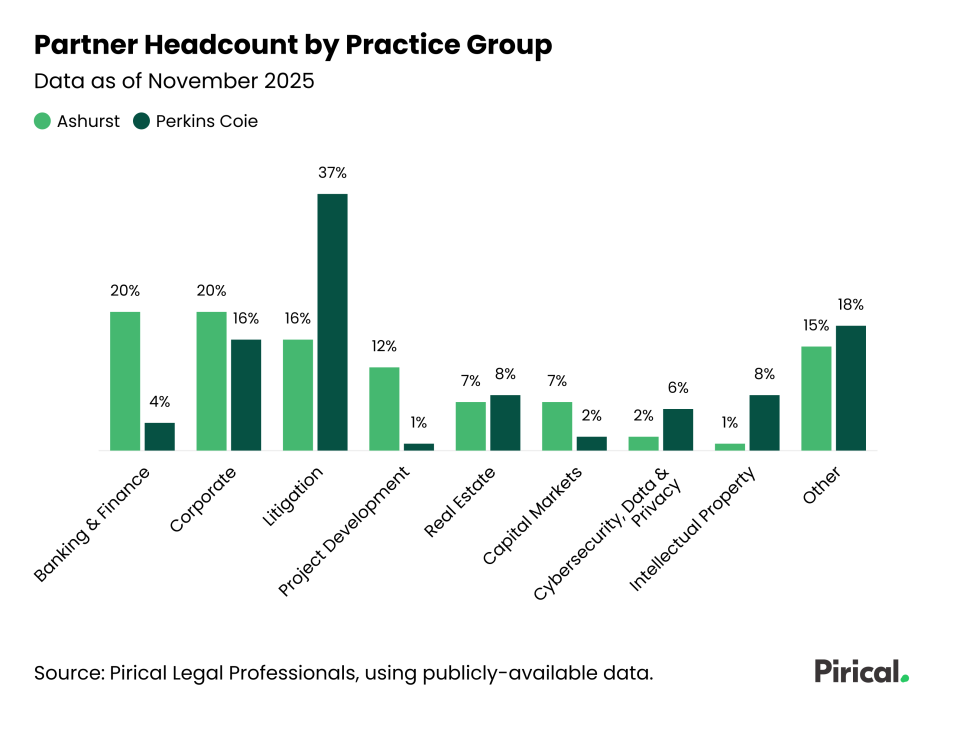
The tie-up has raised eyebrows in some quarters, however, given that Perkins Coie is known primarily as a West Coast tech firm with a high profile in litigation, while Ashurst is known more for banking and finance and corporate work in extractive industries such as mining and infrastructure.
“Ashurst has been looking for a US merger partner for more than 20 years, and Perkins Coie is a great brand,” said Scott Gibson, director of legal recruitment consultancy Edwards Gibson. “It’s not a bad move, it just doesn’t seem like the most natural fit.”
Ashurst was once among the top of the second tier of UK law firms, with a highly successful private equity offering and the clout to court Latham & Watkins, Sidley Austin and Fried Frank in the early 2000s as possible merger partners, though ultimately the talks came to nothing.
The firm hit a rough patch about 10 years ago; revenue fell by 14% and PEP by 24.7% across the 2015 and 2016 financial years, fuelled by a raft of partner departures and a global slowdown in the oil and gas and mining sectors.
Since then, the 1,600-lawyer firm has been on an upward trajectory under the leadership of CEO Paul Jenkins, who is set to become co-CEO of the merged firm alongside Perkins Coie’s managing partner Bill Malley.
Jenkins oversaw an overhaul of Ashurst’s lockstep and the holding back of partners’ profit distributions for a time to shore up its finances. The firm’s revenue topped £1bn ($1.3bn) for the first time in FY25, its ninth consecutive year of growth, as PEP grew to a record high of £1.4m ($1.8m).
However, even as its revenue and profitability have grown, Ashurst’s position in its home market of London has inevitably been challenged due to the influx of highly profitable US firms.
Ashurst has characterised its merger with Perkins Coie as one of equals, with leadership of the combined firm to be split evenly between the current heads of both firms. Jenkins also told the Financial Times the firms would be fully integrated and pool profits.
The firms are broadly similar in terms of revenue – Perkins Coie had turnover of just under $1.3bn in 2024, according to data published by Law.com – as well as PEP, which was $1.9m at Perkins Coie.
Firms with a similar level of profitability can create a common pay structure more easily, though they may still have to overcome challenges of divergent cultures.
However, Gibson points out that a parity in PEP inevitably means that in relative terms, Perkins Coie’s market position is less strong than Ashurst’s, given that firms in the US are able to achieve a higher margin as clients will accept higher charge-out rates.
Ashurst already has a small network of US offices across New York, Austin and Los Angeles that together house around 55 lawyers, according to its website. The firm’s US focus in the merger is underscored by the fact that almost all of Perkins Coie’s 1,060 lawyers are based across 17 US offices, alongside small teams in Taipei, London and Beijing.
A strong practice in the US, where more money is spent on legal services than in all other countries combined, is an imperative for any law firm with serious global ambitions, though UK firms have struggled to build a presence there from scratch.
Allen & Overy sought to address that conundrum last year through its $3.5bn merger with Shearman & Sterling, a deal that created the template for Herbert Smith Freehills’ $2bn tie-up with Kramer Levin Naftalis & Frankel earlier this year.
Unlike those deals, Ashurst’s merger with Perkins Coie won’t give it a particularly large practice in New York – widely viewed as a necessity for a top law firm.
Assuming there are no departures beforehand, the combined firm will have 55 partners in the city, a figure that would put it just inside the top 100 law firms, according to research by Pirical.
For Perkins Coie, though, the merger will bring a significant global network.
Ashurst has 27 offices across 17 countries outside of the US, including a significant APAC presence thanks to its merger with Big Six Australian firm Blake Dawson in 2012. Ashurst and Perkins Coie’s leadership will be hoping to recreate the success of that tie-up.
However, their merger isn’t yet set in stone as it is subject to a vote by the partnership of each firm early next year before an expected completion in Q3 2026, and there are still questions to answer, including about differences in compensation and pensions, as well as possible client conflicts.
It’s also not clear to what extent Ashurst could get dragged into Perkins Coie’s battle with US President Donald Trump, who shortly after the two firms began merger talks earlier this year hit Perkins Coie with an executive order that a judge said posed an “existential risk” to the firm.
The order was later blocked by a federal court, although the Department of Justice is appealing the ruling.
Email your news and story ideas to: [email protected]