
Pinsent Masons is set to form a joint venture in the Qianhai Free Trade Zone with one of China’s top corporate law firms.
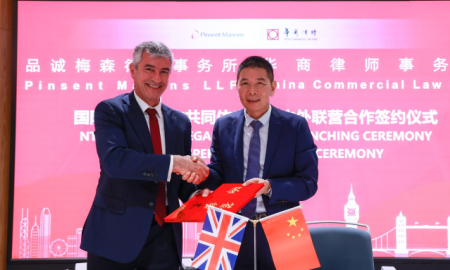
Pinsents said on Monday that it had received government approval to form the JV with China Commercial Law Firm (CCL), in a move the UK-founded firm’s global senior partner, Andrew Masraf, said would help position it to service clients in key areas of global economic growth.
“In particular, we’re well positioned to continue to take the opportunities created by the flow of work between China and the Middle East, especially in the energy and infrastructure sectors,” Masraf said. “We see this as a great driver of work for us across our global network and really plays to our strengths as a firm.”
The JV – known as the China Commercial Law Firm and Pinsent Masons LLP, Qianhai Joint Operation Office – is the first of its kind, Pinsents said.
News of its formation comes just a few months after the firm opened its fourth Greater China office in the Qianhai Free Trade Zone, an experimental business zone in the booming southern city of Shenzhen intended to foster integration between Shenzhen and neighbouring Hong Kong.
The JV will see Pinsents and CCL maintain their independent name and offices, but work together on matters for existing clients and to win work from prospective clients. They will also “bring together their extensive networks in China and globally to service both Chinese and international clients”, Pinsents said in a statement.
Pinsents has operated in China for more than 40 years and is recognised by legal rankings guides as among the top international firms in China in construction, infrastructure and energy.
For its part, CCL has more than 3,000 lawyers across the country and is consistently ranked first in Shenzhen, Guangdong and Southern China in terms of size and revenue.
Pinsents’ head of Asia Pacific, James Morgan-Payler, hailed the JV as a “significant step” in the firm’s growth in the Asia Pacific region.
“Our focus in the region has been primarily on the energy and infrastructure sectors, however these moves into Shenzhen and the joint venture with CCL will provide us with the opportunity to advise clients in key sectors such as finance, technology and logistics, all of which have a heavy presence in the Qianhai Free Trade Zone,” he said.
Gao Shu, chief partner of CCL, added: “This alliance will build a powerful legal entity for Chinese enterprises as they expand globally, but will also, through the deep integration of Chinese and international legal service systems, help redefine the landscape of international commercial law.”
The two firms share a focus on practice areas including energy, infrastructure, M&A, capital markets, banking and finance, real estate and construction, as well as arbitration and mediation, and pharmaceuticals and healthcare.
Kanyi Lui, Pinsents’ head of China and head of its Shenzhen office, said the “partnership of equals” combined Pinsents’ international reach with CCL’s scale and local expertise in China.
“China is one of the most strategically important markets for our clients,” Lui said. “Chinese corporates are also quickly globalising. The combination... reflects our shared commitment to providing clients with seamless, practical and commercial legal solutions in an increasingly complex world.”
The JV is notable for coming at a time when many international law firms, particularly major US firms, are scaling back their presence in China or exiting the country altogether amid simmering geopolitical tensions between China and the West and tightening regulation.
Over the past few years, at least 15 Big Law firms have announced office closures in China, among them Milbank, Paul Weiss, Skadden, Morrison & Foerster, Sidley Austin, Weil and Orrick. Publicly available data tracked by Pirical records that over the last two years, the number of Am Law 100 lawyers based in Beijing and Shanghai has declined by 25% from 569 to 424. The decline over a five-year period is 35%.
Some firms have also been building their China ties, however. Late last year, Dentons rekindled its relationship with Beijing-based Dacheng Law Offices, two years after the firms severed formal ties, citing concerns over Chinese regulations. Mishcon de Reya was also granted a licence to practise as a firm of solicitors by the Law Society of Hong Kong, nearly four years after it entered the market through an association with local firm Karas So.
Email your news and story ideas to: [email protected]