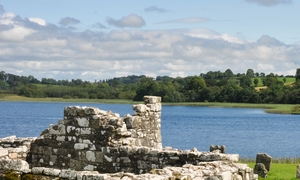
Fermanagh is a quieter place this morning in the aftermath of the G8 meeting but the influx of global leaders to NI has certainly raised the profile of this part of the world. Not only did the event pass without incident but the real Northern Ireland was on parade for all to see. And whilst the jury may be out on what the leaders actually achieved, NI, in its own way and with its history, had something to offer the world.
Finding answers
There will always be varying degrees of cynicism surrounding events that are headlined as having the potential to change the direction that the world’s leaders are intent on taking. Let us be under no illusion that the final communiqué on the G8 will hold all the answers to the current unfolding of events on a global scale - though the announcement of a EU-US trade deal the day before the summit began augers well for the local economy. It would be impossible to come to anything approaching complete agreement on topics as complex and diverse as the conflict in Syria over the duration of a few days in Fermanagh. However, the fact that Northern Ireland has been able to host a gathering of some of the most important and influential figures on the planet must be viewed as much more than a mere diplomatic or economic footnote.
A statement of positive intent
Enniskillen has represented a statement of positive intent for the world and of economic maturity for Northern Ireland.
From a regional perspective, as a still fractured society and economy, the message can and must resonate with those struggling on a daily basis to try and solve seemingly intractable problems.
The sub text of that message is that, after decades and centuries of distrust, the long journey towards a better future is one that now has hope rather than hatred at its heart.
Lessons for the world
It would have been impossible not to have been moved by the inspirational words delivered by President Obama to the children and young people that packed into Belfast’s Waterfront Hall. His impassioned challenge in a speech that repeatedly called for the continuation of positive change in society was equally applicable to the wider world as it was to the youthful audience.
The G8 is often viewed as an ‘official’ world government. The decisions and the agreements that it arrives at ultimately have significant ramifications for interlocking institutions such as the World Bank, the International Monetary Fund and the World Trade Organisation. It is by and large an economic gathering with social implications displayed writ large.
Critics of the G8 argue that the legitimacy of the grouping has been harmed by the limited representation it projects when making pronouncements of global importance.
The missing nations
Those critics, with some justification, can point to the exclusion of the world’s two most populous nations, China and India, from the meetings on the shores of Lough Erne. World horizons have changed totally since 1976 and the establishment by the original six nations of what would eventually evolve into the G8.
The initial remit of the organisation was focused on financial and economic problems. Over the years, however, the agenda has broadened hugely to include a wide range of political, security, social and environmental matters.
Throughout that period, the G8 summits have been characterised by a combination of hard-nosed negotiations complemented by a surprising level of informality. Whilst the decisions taken under the umbrella of the G8 are not binding, they are still critically important in that they indicate the route map of measures the organisation plans to adopt in order to tackle the most pressing world problems.
However, given the economic generation capacity of both China and India, and all the attendant environmental consequences, the G8 badge of global governance lacks full lustre without their involvement. Perhaps that will come in due course with their ultimate inclusion.
A healing salve
The international and economic realities of the 1970s that acted as the catalyst for the genesis of the G8 have changed dramatically in the intervening period. Again the parallels with the admittedly incremental changes in this society can, with much justification, be viewed as the template for evolutionary momentum within the framework of the G8. Indeed one could say that Northern Ireland’s experience can inspire the G8 while at the same time allowing us to continue to work for a better and more inclusive future.
The challenge for continuing change in Northern Ireland society, so eloquently articulated by President Obama, also has to be translated economically and socially, on a scale that has a global reality. At this point it’s worth noting that it’s almost impossible to decide if there will be an economic windfall for Northern Ireland following the summit. It’s too soon to tell and so the social and economic ramifications for the region are something for discussion and conjecture a few months down the line.
However, we can all agree that the holding of the G8 in Northern Ireland has been an incredible achievement in terms of organisational expertise in bringing together a multitude of overlapping logistical strands.
The most telling element, however, of the legacy of Enniskillen is that the splintered past of Ireland can become a healing salve on a truly global scale.
Alan Taylor is managing partner at Arthur Cox’s Belfast office.
Email your news and story ideas to: [email protected]