


Law-firm profitability is shaped by decisions that rarely reach a management meeting.
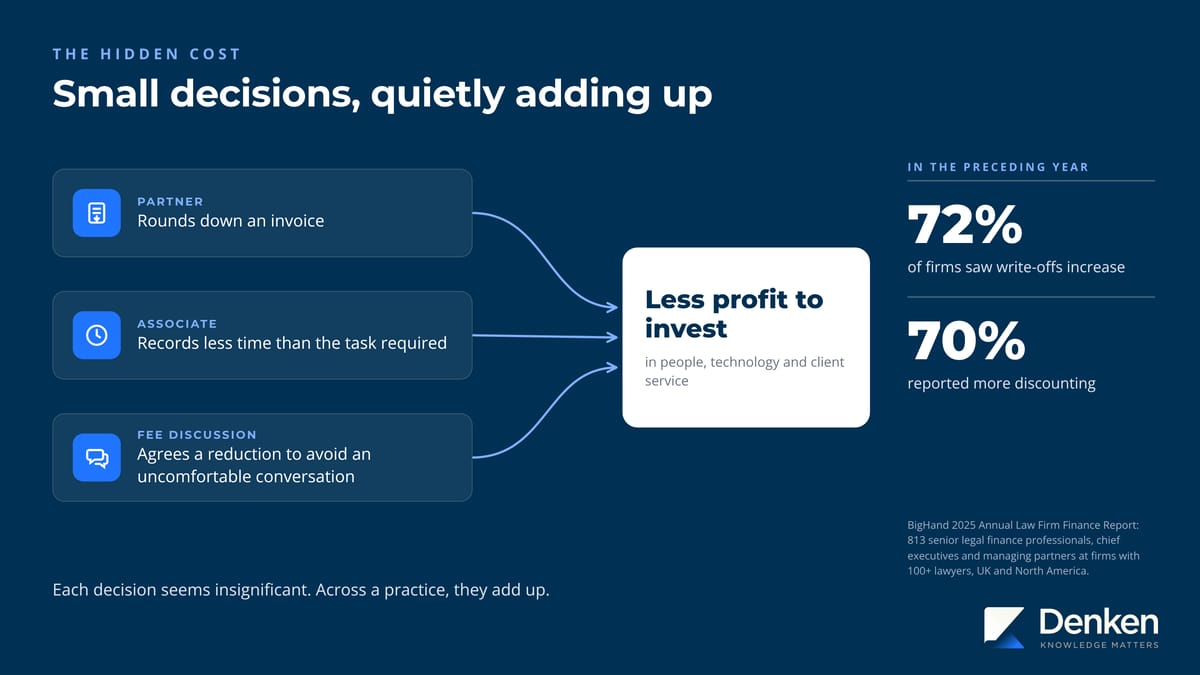
A partner rounds down an invoice. An associate records less time than a task required. A fee reduction is agreed to avoid an uncomfortable conversation.
Each decision may seem insignificant. Across a practice, they can reduce the profit available for investment in people, technology and client service.
The evidence extends across markets. BigHand's 2025 Annual Law Firm Finance Report surveyed 813 senior legal finance professionals, chief executives and managing partners at firms with 100 or more lawyers across the UK and North America. It found that 72% of firms experienced increased write-offs in the preceding year, while 70% reported more discounting.
The challenge is not simply to tell lawyers to resist discounts. It is to help them distinguish avoidable leakage from a justified commercial adjustment.
A discount is not just a reduction in revenue
Consider an illustrative matter with an agreed fee of £100,000 and delivery costs of £65,000. The expected profit is £35,000.
A 10% discount reduces the fee to £90,000. If costs remain unchanged, profit falls to £25,000. A 10% reduction in revenue has removed almost 29% of expected profit.
A concession that appears modest against the invoice can therefore be substantial against the margin.
There may be sound reasons to adjust a fee. The scope may change, a client may offer a credible volume commitment or the firm may deliberately invest in a relationship. Those decisions should reflect cost, capacity and likely return.
Informal concessions can also establish expectations. A successor relationship partner may inherit loyalty pricing that is difficult to explain, renegotiate or sustain.
The gap between work and payment
Clio's 2025 benchmarks state: “The average realisation rate for law firms in 2025 is 88%.” Realisation measures the proportion of billable work invoiced to clients. Its reported collection rate – the proportion of invoiced work paid – is 93%. These benchmarks draw on US law-firm data, rather than a global sample.
These are separate stages. Some recorded value does not reach an invoice; some invoiced value does not become payment. Neither measure captures work that was never recorded.
The figures do not establish that every shortfall is avoidable. They show why firms need to understand where value leaves the billing process.
An associate may under-record because a task felt too slow. Another reconstructs several days from memory. A third records time accurately but provides a description too vague to explain its value.
Accurate recording does not mean every minute should be charged. It gives the billing partner reliable information for a separate judgement about what the client should pay.
Making value visible
Consider an illustrative employment matter. An associate spends a morning examining the risks in a proposed workforce policy, then records the work as “research”.
The billing partner sees the time but cannot readily explain what it achieved.
“Reviewed proposed workforce policy, identified overtime risks and prepared recommendations for partner review” explains more than “research”. It helps the partner assess whether the work was necessary, proportionate and within scope.
The objective is not longer descriptions. It is sufficient specificity to connect the work with the instruction, supporting transparent, defensible bills.
Learning through practical decisions
Denken's profitability series includes a course on the real cost of write-offs, discounting and billing leakage. It uses practical scenarios to show how everyday decisions affect margin. The course material examines a corporate partner who discounts a mandate in anticipation of future work that never arrives. Another scenario follows an associate whose billing review reveals generic narratives, delayed recording and absorbed disbursements.
Learners examine what happened, why value was lost and what could have been done differently.
Adaptive learning provides a common curriculum while adjusting the route according to individual knowledge and responses. Learners can progress through concepts they understand and receive further explanation and practice where gaps remain.
Junior lawyers can understand the economics behind their recording and billing habits, while partners can test established approaches to discounts and write-offs. Firms gain a consistent commercial foundation across offices and practice groups without requiring identical instruction for everyone.
Turning insight into action
BigHand's chief marketing officer, Briana McCrory, summarises the challenge: “It's not just about understanding the data – it's about turning insights into action” (BigHand).
That requires more than a finance dashboard. Lawyers need to recognise how scoping, time recording, billing narratives and fee discussions affect both client relationships and margin.
Training cannot replace sound pricing, supervision or matter management. It can help people understand those disciplines and recognise decisions within their control.
For firms seeking consistent commercial judgement, the priority is to turn financial awareness into everyday practice. Global Legal Post readers can explore Denken's profitability series and how its scenario-based adaptive courses can be deployed across teams, practice groups and offices.
Morgan Rigby is chair and Annika Lehmann is managing director of adaptive learning specialist Denken.
Click here to take advantage of an exclusive Global Legal Post reader offer to access Denken's six-part Law Firm Profit online course series.
Email your news and story ideas to: [email protected]