
On Tuesday (30 June), The Global Legal Post is hosting a live webinar in association with video production company Tin Pan: How Video is Transforming Legal Communications. In this article, panellist Ed Blum, Tin Pan's creative director and founder, explains why video should lie at the heart of law firm marketing, business development and communications.
The world as it is today
When AI first arrived on the scene, we entered the age of authenticity – where firms tried to avoid AI slop and looked to produce authentic content. Now we are moving into the 'age of distinctiveness’ with firms seeking to identify what sets them apart from their rivals. This often rests on trying to capture the firm’s ‘story’ (which does not necessarily mean its history). From that concept, the branding and most of the video content – both external and internal – derive.
The architectural framework to support video strategy
Law firms need to create an interlaced video ecosystem to ensure their strategy is consistent and generates the required return on investment. It should rest on a central platform such as Vimeo or Brightcove, which are developing the video technology that will be needed in the future. This ecosystem will allow video assets to be shared and feature a searchable library, webinar functionality and basic editing tools. The goal is to create an expandable framework where costs can be managed and consistency maintained.
The video engine
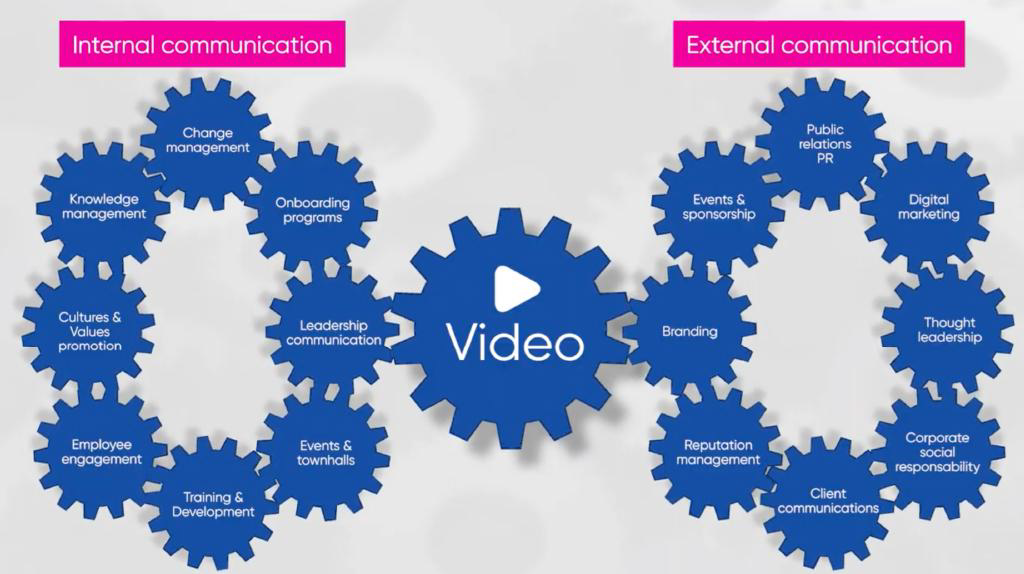
Most firms approach videos the wrong way, with video sitting at the edge as a ‘bolt on’, commissioned when there is budget left over. It should sit at the centre, driving the rest of the firm's marketing and communications. Video should be the one cog at the heart of the engine. Too often, marketing, BD, HR and internal comms buy their own films from their own agencies and in their own style. The engine only works when they work together.
The payoff is reach and consistency. When the centre drives everything, a single decision reaches the whole firm, creating one voice, internally and externally.
One story at the peak, three tiers below it
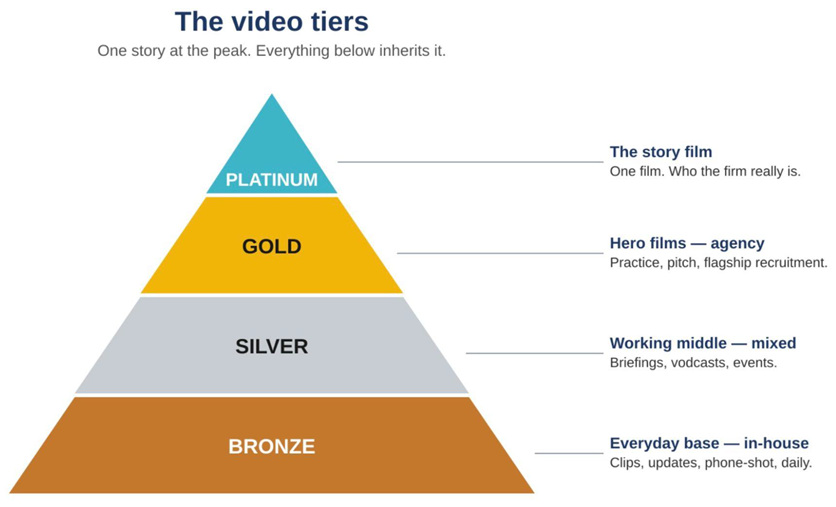
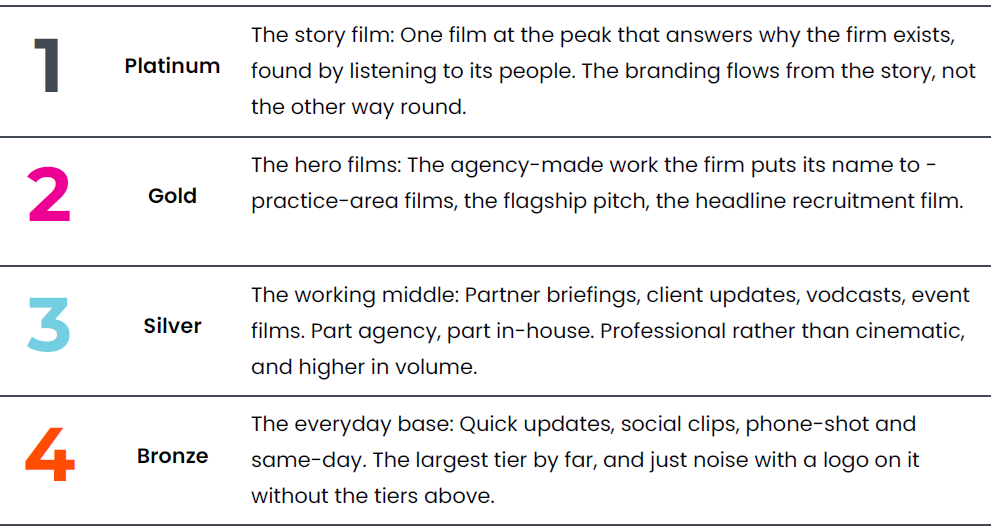
This triangle creates a framework for commissioning. There are four tiers, each with a different job, a different maker and a different budget. Every tier inherits the one above it, which is what stops expensive, inconsistent noise.
How technology fits
Creativity stems from the human touch. AI-generated videos should be applied cautiously in front of the camera; often, the films generated give you the average of everything it has seen, which is the opposite of distinctive. However, it is a powerful tool for tasks such as content ideas, transcription, translation, chaptering, clearing old libraries and finding patterns in data. The judgement and the face should stay human.
The video platform is the foundation, providing one connected system in which to create, store, edit, share and measure. Integrating these five tools rather than stitching them together is a strategic choice and should not be an IT afterthought.
Data that lets the firm adapt
Build the engine and the triangle on the right platform, and you have an ecosystem in which every film is connected, every view is measured, and all the parts learn from each other. This is what changes how a firm works, because measurement stops being a vanity number and becomes the instruction for what to make next.
- Measure everything: Analyse who watched, for how long, where they stopped, and what they skipped. Most teams still count only opens and clicks. Video, measured properly, tells you far more.
- Let the data shape the content: Do more of what holds attention, less of what gets abandoned at ninety seconds. The ecosystem adapts continuously rather than guessing once a year.
- Interactive video reveals intent: Give the viewer choices, as the choices show what they care about. A single send becomes a map of what a prospect actually wants, and the analytics run far deeper than a play count.
- Build it to expand: Film once, publish everywhere. A town hall or vodcast can become a long-form piece and generate short clips, an audiogram and an article. The system can scale without re-engineering.
ViewFinder: where marketing and sales become one
Business development is where the line between marketing and selling dissolves. At Tin Pan, we've built a full marketing-to-sales journey inside a single interactive video. We call this model ViewFinder.
The principle is simple. A normal film tells you how many people watched and for how long, numbers that disappear into a black box. Sales receives no signal from it and follows up blind. ViewFinder turns that same send into something that talks back. By giving the viewer genuine choices, the video reveals not just that someone watched, but what they cared about: which topics they explored, which they skipped, where they leaned in, and whether they were close to acting. A single link becomes a map of what a prospect actually wants, so the people who follow up know intent before they pick up the phone.
That intelligence doesn't sit in a silo. Marketing owns the content and the brand, sales reads individual intent, and leadership sees which themes resonate across a whole audience – all working from one picture rather than three disconnected ones. And because the same link improves every time it's sent, the asset never goes stale: each campaign builds on what the last one revealed instead of starting from zero.
ViewFinder features:
Intent revealed through viewers' choices.
What they explore and what they skip is the real signal.
Content that gets better the more it's watched.
Marketing, BD and sales working from one video journey.
Ed Blum is Tin Pan's founder and creative director. He is a panellist for next Tuesday's webinar, How Video is Transforming Legal Communications, alongside Sadie Baron, chief marketing officer, TLT (moderator), Alex Novarese, director, Byfield, Laura Klysz, global head of marketing and communications, Simmons & Simmons, and William Brewster, former global head of communications, Clyde & Co and a leadership communications consultant. Click here to register for this live video, which takes place on Tuesday, 30 June from 11 am-12 pm.
Email your news and story ideas to: [email protected]