
From inspiration for designs and mood boards to managing supply chains and inventory through predictive modelling, AI is increasingly being adopted by fashion brands to support their operations, even going as far as enhancing customer experiences through AI capabilities such as virtual try-ons.
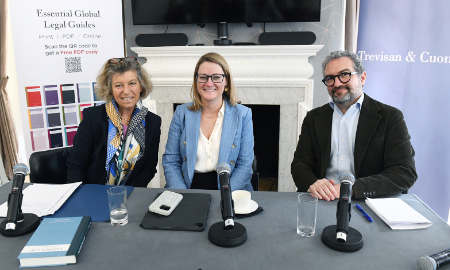
But this AI adoption is raising a breadth of legal and IP issues for brands, which were explored at a recent roundtable event to launch Global Legal Post’s Law Over Borders Fashion Law Guide, hosted by Trevisan & Cuonzo partner and guide editor Julia Holden, alongside panellists Megan Bannigan, a partner at Debevoise & Plimpton, and Matt Hervey, senior associate general counsel – AI strategy at Cloudflare.
With AI increasingly being embedded into creative and design processes, this is posing questions about copyright and what level of protection is afforded to AI-powered designs.
“What the US Copyright Office and the courts have been very clear on is that if it is machine-created, there is no copyright protection,” said Bannigan. “It’s a narrow scope, because the law says that if there are human-created elements, those do have copyright protection.
“Now the question is, what was machine-created and what was human-created? If you start with a human-created sketch and you ask AI to enhance it, there will be arguments that there is protection.”
However, different machine-created elements when combined may be copyright protected, Bannigan says, pointing to a recent US case relating to a comic book where the underlying AI images weren’t protectable but the composition of those images on the page was eligible for copyright protection.
In Europe and China, cases have typically centred on whether the user was able to exert genuine control over the expressive content, says Hervey.
“For most prompts, you’re defining the subject matter, and you’re giving some broad description of a style, but you cannot predict or control what the output really looks like in terms of copyright-protected elements,” he said.
Hervey adds that “one weird nuance” exists in a handful of countries, including the UK, where there are specific rules for copyrighted works without a human author.
“For the UK, at least, no one expects that to work, because the way our law was drafted, the work still needs to be ‘original’, and under our law, ‘original’ requires human intellect,” said Hervey. “Our copyright office acknowledges the law is unclear and contradictory,” said Hervey.
Holden questioned who would be held liable if an AI system is trained on copyrighted materials. For Hervey, just because a model has been trained on copyrighted material, it doesn’t mean every output would be infringing. But, for example, a fashion company might then try to rely on any indemnity from its AI supplier.
“Companies should have their own acceptable use policies about how to use AI: that individuals are responsible for the outputs they decide to use, and that they should do some basic reverse searches online to check that an output isn’t an obvious infringement,” he said.
Holden also raised a question around how opt-out mechanisms for copyright holders will work in practice, given content that is on a website can be scraped anywhere in the world.
“I’m very sceptical at this point that copyright opt-outs will be enough, but I do think that it’s an area that we’re going to see develop a little bit more, because in the US at least we’re going to get more decisions and not all of this is going to be fair use, so there is going to have to be some kind of opt in, opt out licensing structure… but it’s hard to see exactly what that’s going to be,” said Bannigan.
Hervey adds that there needs to be a combination of scarcity to force AI companies to agree to licensing deals alongside efforts to make the licensing process more convenient.
Another issue that is emerging for fashion brands is using generative AI to replicate fashion models in ad campaigns.
“In the EU, there are unanswered issues around privacy and if potential biometric data, such as faces, allow talent to prevent training deals, regardless of the copyright position,” said Hervey.
All of these issues are creating a complex AI litigation backdrop for IP lawyers and brands to navigate.
“From a litigators perspective, this is going to be a disaster,” said Bannigan. “If you think of the discovery – have you used AI? How did you use AI? What did you do with my design?
“It will be a way for designers and brands to potentially get more protection than they had before and to be able to enforce rights against designs that you otherwise would have had no way to protect against. But in order to figure that out, you’re going to have to know that the alleged infringer used AI in this way, and how are you going to know that? This is going to be so messy from a discovery perspective.”
The Global Legal Post Law Over Borders comparative guide to Fashion Law is written by leading fashion and IP lawyers from across the world and serves as a practical resource for general counsel, brand owners, lawyers and advisers working in the fashion sector.
It explores how the law governing brand protection, e-commerce and marketing impacts the fashion sector in key jurisdictions. It also assesses evolving sustainability requirements.
It is available online, to download as a PDF and to purchase in its hard copy format. Click here for more details.
The Fashion Law guide is one of 18 titles in the Law Over Borders series, which also covers topics including arbitration, artificial intelligence, cryptoassets, data protection, ESG and restructuring and insolvency.
Forthcoming guides include: Shipping, Private Funds and Blockchain. For further information about the guides, email [email protected].
Email your news and story ideas to: [email protected]