

Every dupe is tested by our expert team – Dupeshop
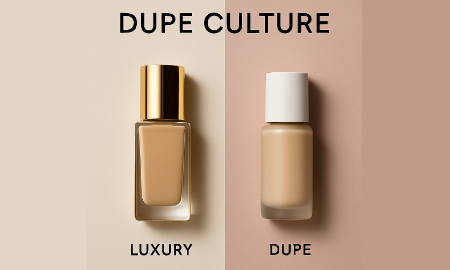
Dupe culture is a consumer trend driven by Gen Z and social media, prioritising affordable alternatives (‘dupes’ is short for duplicates) that mimic the aesthetics, quality or function of high-end luxury brands. Dedicated Instagram handles such as @Dupeshop and @Dupethat curate makeup twins for millions of followers.
Dupe.com has gone further still, building a personalisation engine that matches shoppers to alternatives based on declared buyer personality – so the same product search surfaces different recommendations depending on whether you prioritise longevity, peer reviews, expert opinion, specifications, value or price. What was once whispered imitation is now algorithmically amplified comparison.
While this trend drives engagement, it also creates legal and brand-protection challenges. Dupes challenge the foundations of branding and cultural trust by thriving in the grey areas that intellectual property (IP) frameworks were not designed to police. When does comparison become unfair and when does imitation become infringement?
The now-infamous Walmart ‘Wirkin’, widely understood as a visual echo of the Hermès Birkin, did not bear the Hermès mark. Yet the resemblance was unmistakable.
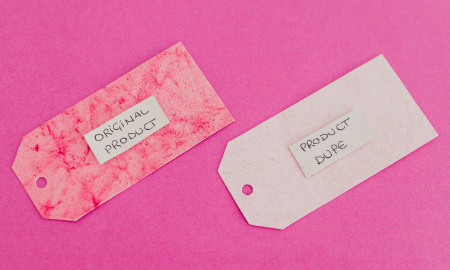
Typically, dupes operate across a spectrum. Pure dupes are distinctively branded, lower-priced alternatives that avoid direct IP violation. Risky dupes are aesthetically close enough to evoke association and invite confusion claims. Infringing dupes reproduce protected trademarks, trade dress and/or design elements. The distinction lies in what and how much is being copied; determining permissibility involves a layered analysis of factors that this article seeks to set out.
Technical boundaries of protection
Trademark law protects brand identifiers and trade dress, copyright protects artistic elements and design law guards aesthetic features of shape, configuration, pattern, ornament and so on.
For years, brands have targeted dupes through trademark and trade dress litigation, with plaintiffs having to prove distinctiveness, non-functionality and consumer confusion. Often shapes, colours, silhouettes or minimalist packaging elements are held to be generic or industry standard. Given the difficulty in proving dupe claims based on IP rights alone, brands are now pivoting. Instead of arguing about the appearance of dupes, they are challenging the marketing language of dupe sellers. The real battleground is, therefore, shifting from product resemblance to advertising claims.
Few brands illustrate the commercial sophistication and legal tightrope of dupe culture more sharply than MCoBeauty, an Australian cosmetics giant with widespread presence across the US. MCoBeauty transformed its business model by deliberately recreating viral luxury beauty products using closely similar packaging aesthetics and naming signals, all the while pricing them significantly lower than the originals.
This evolution has been methodical rather than incidental. Its founder has been reported to publicly explain: “We have a very stringent process that we go through when we decide that we want to launch a product… we have a whole product development team of about 10 people, and we have a great external lawyer… and we have a look at the product packaging, and then we go through a process of seeing that… there’s no trademarks and there’s no patents.”
Some would say that what emerges is a calculated model of duplication built on carefully studying and operating within the technical boundaries of trademark protection.
MCoBeauty’s model has not been litigation-free. In 2021, Tarte Cosmetics sued MCoBeauty over its ‘Shape Tape’ concealer packaging. The same year, Chemcorp, the maker of the popular 1000Hr eyebrow dye, sued MCoBeauty over its competing product named ‘2000Hr’. These early disputes were fought on familiar trademark terrain, focusing on similarities in packaging and the closeness of product names.
In November 2024, Sol de Janeiro, a prestige body care brand, sued MCoBeauty in the US District Court for the Southern District of New York, alleging that MCoBeauty had copied the trade dress of its Cheirosa body mist range through similar bottles, colour coding, caps and labelling. More significantly, however, the action also targeted the advertising narrative surrounding the products, focusing on false advertising, comparative positioning and claims of equivalence. Sol de Janeiro contends that MCoBeauty, including through influencer-led promotion, cultivated a misleading impression that its mists were equivalent to Cheirosa fragrances in smell and performance.
The Williams-Sonoma v. Quince litigation in the US, filed in November, is another useful example of this shift. Williams-Sonoma, a retailer of premium home goods, did not sue affordable luxury brand Quince for trade dress or design infringement. Instead, it framed the case as one of false advertising and unfair competition.
The complaint challenges Quince’s ‘Beyond Compare’ charts and slogans such as ‘Like Williams-Sonoma, but half the price’ and ‘Pottery Barn quality for half the price’, alleging that these claims misled consumers into believing that Quince’s products were directly comparable in design and quality to Williams-Sonoma brands, when they were not. Williams-Sonoma also alleged that some of the reference products shown in Quince’s advertising were not products it had sold at all.
A useful older reference point is L’Oréal SA v. Bellure (Court of Justice of the European Union, 18 June 2009). In that case, the defendants sold ‘smell-alike’ perfumes and used comparison lists linking their cheaper fragrances to L’Oréal’s well-known perfumes. What makes the decision especially relevant to dupe culture is that the court accepted that liability could arise even without confusion, dilution or tarnishment. It was enough that the defendants had created a mental link with L’Oréal’s reputed marks and thereby taken unfair advantage of the latter’s attraction, prestige and advertising value.
The legal problem with dupes may lie not only in copying appearance, but also in comparative claims and marketing devices that trade on the cachet of the original brand to sell an imitation.
Indian position
In India, dupe culture is no longer peripheral and the fragrance market serves as an effective example of that. Fashion publication The Voice of Fashion reports that in 2023, the fragrance market in India was valued at roughly $1.35bn and is expected to grow at a rate of 11.3% until 2029. It also states that the internet is rife with content that compares luxury perfumes with their affordable counterparts.
Because scents are hard to describe and smaller brands often lack the distribution reach of established players, comparison with recognised luxury fragrances becomes the easiest way to signal what is being sold and drive purchases. Furthermore, luxury fashion houses have not been passive where visual mimicry is concerned. In 2019, the Delhi High Court restrained Ramsons Perfumes from marketing a fragrance in a dumbbell-shaped bottle found to closely echo the trade dress of ‘Davidoff Champion’, and, more recently, in 2024, granted similar relief against Petrol Perfume’s ‘Mr. Petrol’ line, whose packaging was found to replicate the look of Burberry’s ‘Mr. Burberry’.
That said, dupes are yet to be assailed through the prism of advertising law in India. Even so, looking at the applicable framework is instructive.
Comparative advertising is, of course, permissible, provided it is factual, substantiated and free from unfair denigration; when advertising claims are misleading, tarnish brand reputation or exaggerate similarity, legal vulnerability can arise. Puffery is permitted as long as it does not disparage.
Sections 29(8) and 29(9) of the Indian Trade Marks Act of 1999 function as critical pressure points. Section 29(8) provides that a registered trademark is infringed by any advertising of that trademark if the advertising:
(a) takes unfair advantage of and is contrary to honest practices (free-riding); or
(b) is detrimental to its distinctive character (dilution); or
(c) is against the reputation of the trademark (tarnishment).
For instance, if a smaller brand markets itself as a ‘Lululemon dupe’, it is not merely identifying a point of comparison; it is leveraging Lululemon’s accumulated goodwill and aspirational equity to signal parity. Even without copying logos or identical branding, this positioning may be characterised as free-riding. It is perhaps reflective of this evolving battleground that Lululemon has secured a trademark for the phrase ‘Lululemon Dupe’ in the US.
Section 29(9) of the Indian Trade Marks Act sharpens this framework further by extending infringement to spoken use of a registered mark. In an era dominated by reels, an influencer’s verbal reference to a competitor’s brand in a promotional setting can therefore trigger liability.
The Advertising Standards Council of India’s (ASCI) Influencer Advertising Guidelines mandate clear disclosure of material connections with brand owners and require that all endorsements be truthful, substantiated and not misleading. Describing a product as a ‘dupe’, an ‘exact match’ or ‘the same but cheaper’ constitutes a commercial claim governed by the ASCI Code. Assertions of equivalence in quality, composition, performance or longevity must be capable of substantiation, and advertisers remain responsible for claims disseminated on their behalf. In a marketplace fuelled by viral recall and influencer amplification, this creates a stringent compliance layer that echoes influencer marketing regulations in the US and EU.
Promises, promises
Ultimately, dupe culture tests the resilience of trademark protection, the flexibility of comparative advertising and the credibility of marketing narratives. For brands, identity is currency. When that identity is diluted not by copying a logo, but by asserting sameness where a material difference exists, the law may intervene.
The future of dupe litigation will not hinge solely on whether rival products look alike. It will turn on what is promised, what is implied and what can be proved. This shift is important not only doctrinally, but tactically. In classic trade dress litigation, the burden typically lies on the brand owner to establish distinctiveness and protectability. False advertising claims, by contrast, place pressure on the dupe seller to substantiate assertions of equivalence, quality or performance.
For luxury and fashion brands across sectors – whether cosmetics, clothing or accessories – this shift is consequential, because what they market is not merely quality, but exclusivity, reputation and aspirational distinction – attributes that dupe culture does not simply replicate, but seeks to monetise and, in the process, blur.
Bisman Kaur is of counsel at Remfry & Sagar. She is a trademark attorney with more than two decades of experience in advising clients on how to optimise protection and unlock brand value. Bisman takes a keen interest in fashion and is also a part of the firm’s fashion and luxury law practice. She is editor of the firm’s newsletter and leads media outreach, communications and publishing activities, ensuring clients and associates are updated on IP developments. Bisman can be reached at [email protected].
Aarti Aggarwal specialises in IP litigation, with a strong focus on fashion and luxury law. Her practice spans trademark, copyright, advertising and marketing disputes, including pre-litigation strategy, risk assessment and mitigation, infringement actions, domain name conflicts and dispute resolution. She regularly advises fashion and lifestyle brands on brand protection and enforcement. She can be reached at [email protected].
Email your news and story ideas to: [email protected]