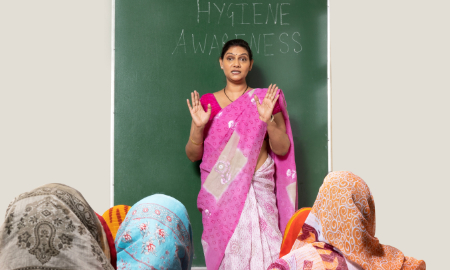


In January 2026, India’s Supreme Court ruled that the right to menstrual health falls within the right to life as guaranteed under Article 21 of the Indian Constitution.
With International Women’s Day having been marked last weekend by women lawyer leaders, the decision merits a closer look to assess its possible global impact, not least given UN Women’s theme of ‘Rights. Justice. Action. For ALL Women and Girls’.
The Supreme Court of India ruled that the right to menstrual health is included within the right to life under Article 21 of the Indian Constitution. The judges commented that “access to safe, effective and affordable menstrual hygiene management measures helps a girl child attain the highest standard of sexual and reproductive health”.
The court concluded that menstrual hygiene management and privacy measures are inextricably linked to the right to live with dignity and, in turn, to the right to life. In its ruling, it acknowledged the causal link between the inaccessibility of menstrual hygiene management measures, stigma around menstruation and absenteeism in schools.
In concluding that the right to equality is expressed through the right to participate on equal terms, the court noted that the domino effect of the absence of education is the inability to participate in all walks of life later.
This decision applies across non-fee-paying and fee-paying schools in both urban and rural areas. With India the most populous country in the world – the UN estimates its population reached 1.472 billion in 2026 – one cannot underestimate the momentous effect this decision will have on menstruating girls across India, in particular, its impact on combatting absenteeism among girl students in India.
The judgment was accompanied by sweeping directions. Specifically, all Indian states and union territories were asked to ensure the distribution of biodegradable sanitary pads free of cost to girl students across all schools.
The court also ruled that all schools should be equipped with functional and hygienic gender-segregated toilets with usable water connectivity, and relatedly, schools need to ensure that all existing and new toilets are maintained or designed to ensure privacy and accessibility, including catering to the needs of children with disabilities.
Lastly, it ordered greater accessibility to washrooms in schools, which it said should establish ‘Menstrual Hygiene Management’ corners equipped with items such as spare underwear and uniforms.
The ruling matters because menstrual inequity remains a major global issue. According to UNICEF, at least one in 10 women and girls in rural areas across 12 countries did not have a private place to wash and change during their last period.
The United Nations found that around 20% of girls in India drop out of education entirely after their period begins, while in Afghanistan and Nepal, up to 30% of girls miss school every month during their period.
This issue is by no means exclusive to developing countries. Within the US, research indicates that one in four teens and one in three adults struggle to afford period products, especially teens of colour and lower-income households.
Within the UK, progress has been made over the last decade. In 2018, the Scottish government made history in passing the Period Products (Free Provision) Scotland Act. The landmark legislation made Scotland the first country in the world to protect, in law, the right to access free menstrual products for anyone who needs them.
Wales and, subsequently, Northern Ireland also introduced schemes to provide free menstrual products in certain locations, including schools. In England, the government committed in 2019 to funding a similar scheme.
That result followed a campaign by Free Periods, in partnership with the Red Box Project and supported by The Pink Protest and Hausfeld for legal advice. According to the BBC, the scheme has been used by 99% of England’s secondary schools since its inception.
How the directions will be implemented remains to be seen, but the judgment signifies undeniable progress for combatting menstrual inequity among schoolchildren and adds meaningful momentum to global progress on the subject.
Ingrid Gubbay is of counsel and Cara Nicholson is an associate at Hausfeld in London.
Email your news and story ideas to: [email protected]