The Kochi-Muziris Biennale, founded in 2010 by a collective of artists, is India’s first and largest international exhibition of contemporary art. It takes place every two years in Kochi’s Fort Kochi and Mattancherry neighbourhoods, and brings together artists from across India and the world, with works spanning diverse mediums and disciplines.
The sixth edition of the Biennale, which focuses less on finished works and more on the processes that create art, concludes in March. For a first-time visitor (such as the author who also happens to practise IP and fashion law), its fascinating exhibits provoke an analysis of issues of ownership, attribution and use of craft.
Artisanal process and authorship
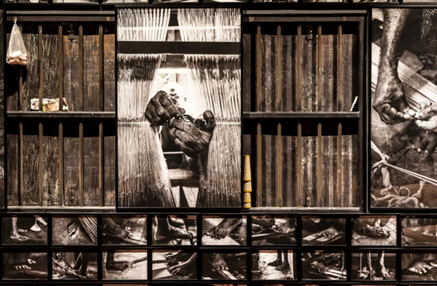
The ‘Looming Bodies’ exhibit by Lakshmi Madhavan features 750 photographs that showcase the weaving community of Balaramapuram fabricating the kasavu textile – a traditional white and gold handloom fabric of Kerala. The ‘makers of cloth’ transmit heritage, memory and process through the daily act of repetition and rhythm of the textile loom, and attention is drawn to how their skill is merely marked in hours spent at work. The shift of attention from the textile to the human labour that creates it collapses the boundary between artisan and artist.
From a legal perspective, this is significant because the value of the work lies less in the finished object than in the underlying craft knowledge. Yet that knowledge sits awkwardly within existing intellectual property categories, which tend to separate the designer (as creative originator and author) from the artisan (as skilled executor). The installation exposes a broader dilemma that is increasingly visible in fashion as well: contemporary designers often draw heavily on traditional craft techniques, yet the legal protection is focused on the final artistic expression rather than the knowledge systems that make it possible. Might joint authorship or moral rights claims be entertained in certain contexts?
The closest mechanism of protection within Indian law remains geographical indications (GIs) under the Geographical Indications of Goods (Registration and Protection) Act, 1999. Notably, ‘Balaramapuram Sarees And Fine Cotton Fabrics’ was registered as a GI in 2009. By linking the textile to its place of origin and traditional method of production, the GI tag protects this heritage from powerloom imitations.
Yet, in the context of contemporary fashion, designers frequently reinterpret kasavu textiles in collections – moving beyond its specific geographic locality and sometimes combining the fabric with embroidery, dyeing or non-traditional silhouettes. These adaptations generally fall outside the scope of GI enforcement because they transform the textile into a new design product rather than reproducing or evoking the GI-protected article itself.
Cultural appropriation
This raises the question of cultural appropriation. When craft techniques migrate into global fashion contexts, the resulting work may be legally protected as a new artistic creation even though the underlying technique originates in a specific community. The Biennale itself demonstrates how frequently this occurs. Textiles, dyeing traditions and weaving patterns appear within installations by artists who are often geographically or culturally distant from the communities that developed those techniques.
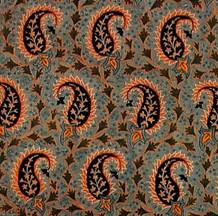
But the exhibition does not present this exchange as appropriation. Instead, it highlights the layered histories of trade and migration that have always shaped craft traditions. For instance, though not a motif featured in the Biennale, the buta, or boteh, motif – globally recognised today as paisley – is perhaps the most famous example of a travelling textile design. Originating in Persian decorative arts, the motif became closely associated with Kashmiri shawl weaving between the 17th and 19th centuries. When European manufacturers began reproducing these shawls during the colonial period, large-scale production emerged in the Scottish town of Paisley, from which the motif eventually derived its modern name.
Craft in the age of global design
In the context of present-day fashion, Indian embroidery techniques, handloom weaving, natural dyeing and textile surface design have become key differentiators for luxury brands worldwide.
For lawyers and designers alike, the exhibition raises a deeper question: how should the law protect cultural knowledge that is simultaneously collective, evolving and globally influential? The answer likely lies not in a single legal mechanism but in a combination of tools – geographical indications, contractual collaborations with craft communities, attribution frameworks and ethical sourcing practices.
When Prada debuted a toe-ring sandal in its Spring/Summer 2026 Men’s Collection, it drew instant parallels with the GI-tagged Kolhapuri Chappal in India. Prada went on to publicly acknowledge conscious inspiration and announced a partnership with the government-backed leather industry bodies of Karnataka and Maharashtra to produce a limited-edition ‘Made in India’ collection inspired by Kolhapuri Chappals, scheduled to debut globally. This outlines a model of acknowledged inspiration (to obviate claims of cultural appropriation) and commercial partnership (with equitable artisan participation at its centre) that can augment brand value.
Returning to the Biennale, an apt metaphor to close is offered by Faiza Hasan’s installation. A gleaming, foaming sea wave poised to break is rendered across the floor from sheets of beaten silver varkh, a fine filigree foil sheet of pure metal, typically silver but sometimes gold, traditionally used to decorate Indian sweets and food. It embodies for the author the churn of ideas as they voyage through trade and time and the beauty that emerges therein. The conclusion that arises is that protecting artisan processes and networks – rather than only the final product – may lie at the heart of intellectual property law in the age of global fashion and design.
Bisman Kaur is of counsel at Remfry & Sagar. She is a trademark attorney with more than two decades of experience in advising clients on how to optimise protection and unlock brand value. Bisman takes a keen interest in fashion and is also a part of the firm’s fashion and luxury law practice. She is editor of the firm’s newsletter and leads media outreach, communications and publishing activities, ensuring clients and associates remain updated on IP developments. Bisman can be reached at [email protected].
Email your news and story ideas to: [email protected]