
Chapters in this guide
24











Like many other industries the fashion industry is undergoing a technological revolution. From virtual models and automated design processes to AI-supported trend analysis, there is hardly an area that remains untouched by the influence of artificial intelligence. At first glance all this sounds like wonderful innovation but a closer look raises critical questions: Can algorithms really replace creativity? What will happen to the jobs of designers, stylists, and production workers? And how much individuality will remain if fashion is increasingly created from data rather than inspiration? While major brands focus on efficiency and profit maximisation, critics warn of growing uniformity and a loss of cultural depth in fashion. The hype surrounding AI is huge — but it comes at a price if we do not use it wisely.
The law set out below is applicable.
| IPR | Duration | Time and modalities for grant | Pros and cons in the fashion sector |
| Trademarks | No time limits, but regular renewal is required every 10 years. | About 3 months. Applications are lodged with the German Patent and Trademark Office. Distinctiveness is required but there is no requirement regarding availability. | Pros: · Broad protection for distinctive signs. · No time limits. Con: The scope of protection can be narrow due to the high number of registered trademarks. |
| Design | Up to 25 years. Unregistered EU designs: 3 years from initial publication. | About 3 months. Applications are lodged with the German Patent and Trademark Office. Novelty is required. | Pro: Quick. Con: No examination before court proceedings. |
| Trade secrets | No time limits. | Automatic protection. Reasonable documentation is required. | Pro: “Free” protection of the information. Con: Difficult to enforce — questions of evidence. |
| Domain names | No time limits, but regular renewal is required. | Purchase from, and registration with, any domain provider.
| Pro: Cheap. Con: Protection depends on current use. |
| Patents | Up to 20 years. | The process can take up to 5 years. Applications are lodged with the German Patent and Trademark Office. Novelty is required. | Pro: Strong, enforceable protection. Con: Long duration of the application process and high costs. |
| Utility models | Up to 10 years. | Filing with the German Patent and Trademark Office. | Pro: Quick. Con: No examination before court proceedings. |
| Copyright | 70 years after death of the author. | Documentation of work and first publication. Automatic protection. | Pro: No extra costs. Con: High level of originality required. |
Non-traditional trademarks. These can be registered in Germany if they comply with the general rules for trademark protection, especially sections 3 and 8 of the German Trademark Act (MarkenG), which state that any sign must be distinctive and must not be kept free for third parties.
Colour marks. Colour marks can be granted protection if they have a distinctive character in relation to the claimed goods and services. They are usually registered by achieving a secondary meaning (Verkehrsgeltung). When applying for a single colour mark, an internationally recognised identification code must be indicated (ECJ C-104/01). However, colour mark registration often must come second to the public interest of keeping a colour free for use due to the limited number of colours actually available. As a result, colour marks play a minor role in the fashion industry with companies rarely seeking to register them. This may change with the arrival of the “quiet luxury” trend which concentrates more on the classic and iconic aspects of the products rather than gimmicks or the use of logos.
Shape marks. Problems arise if a shape mark is based solely on the shape of the product. In such cases, the shape can only be protected under trademark law if consumers perceive the product-dependent shape mark to be an indication of origin, which means it should distinguish the goods from others in the industry (ECJ, C-136/02). Trademark protection cannot, however, be granted for anything that goes beyond the origin of the product, for example, the purely aesthetic features of the product.
Personal names. In the fashion industry, the use of names as trademarks is quite popular. Basically, they are distinctive and registrable. The use of identical names as pure model designations in addition to any other trademark could lead to trademark infringement if the model designation could be considered to be a second trademark and not just a descriptive designation (cf. Federal Court, I ZR 195/17 “SAM”).
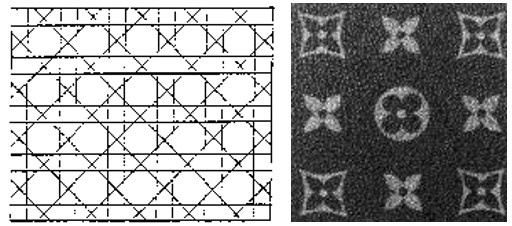
Pattern marks. Pattern marks are registrable provided they are distinctive. Examples of patterns accepted by the German Patent and Trademark Office include international registration 580 546, in relation to a Christian Dior pattern, and German trademark 2 091 389, in relation to a Louis Vuitton Malletier pattern.
Position marks. In the fashion industry position marks are quite popular, such as the famous red sole of Christian Louboutin shoes. Their registration, however, requires that the position is not usual for the specific product category so that it may be considered a sign of the product’s origin. A recent example of a registered mark is Veja Fair Trade S.A.R.L. – DE 30 2022 106 687, relating to the V-shape pattern on the side of Veja sneakers.

Certification marks. Certification marks indicate that the goods or services bearing the mark have certain characteristics certified by an independent body. Therefore, only a person who is not the producer of the goods may be the proprietor of a certification mark. The certified product characteristics, conditions of use, as well as the testing and monitoring procedures must be defined in a statute. The German Patent and Trademark Office allow the certification character to be taken from the trademark itself, although this is not reflected in the corresponding EU legislation (Directive (EU) 2015/2436 of the European Parliament and of the Council of 16 December 2015 to approximate the laws of the Member States relating to trademarks).
To date just a few certification marks have been registered in Germany, for example, the logo of Gruener Knopf (No. 30 2019 111 304).

The German design register mainly shows designs for shoes, bags, single pieces of clothing or patterns. 3D forms are often not registerable as trademarks and do not meet the requirements for copyright protection. For such shapes, design protection is the right tool to use. However, design protection requires novelty, which means that registration needs to be requested no later than 12 months after the first disclosure (section 6, German Design Act). In addition, a design needs individual character to differ from pre-existing designs on the market. As designs are not examined before registration, the German register contains quite a number of designs that may not qualify for design protection because they lack novelty.
If a design is not intended to last for more than two or three seasons, protection as an unregistered EU design may be sufficient (Article 11, European Union Design Regulation). This requires detailed documentation of the first publication and is especially attractive for seasonal fashion products, or Modeneuheit (New Fashion).
Registered design protection lasts for a maximum of 25 years and must be renewed every five years. Unregistered designs are protected for three years from first publication.
The threshold when seeking copyright protection for fashion items under section 2 of the German Copyright Act (UrhG) is still quite high because any piece of clothing or bag must possess the required level of originality (which must not be indicated by the product’s purpose or use). German courts are reluctant to accept that fashion pieces are sufficiently original and instead consider whether they are protected as unregistered designs or under unfair competition law.
Under section 2 of the UrhG, protected works in the artistic domain include, in particular, artistic works such as applied art and drafts of such works, photographic works such as works produced by processes similar to photography, and illustrations of a scientific or technical nature, such as drawings, plans, maps, sketches, tables and three-dimensional representations. This can include the protection of garments, drawings or patterns.
In February 2025, the German Federal Court (BGH) dealt with copyright protection of everyday objects — the Birkenstock sandals. It argued that the design of the sandals is only based on technical requirement and formal design elements which do not lead to a creative design that could be granted copyright protection (case reference I ZR 16/24, I ZR 17/24 and I ZR 18/24). Even if the footbed and the fastening of the straps could be considered as design elements, the creative scope of the sandals was not beyond common everyday design.

Copyright expires 70 years after the author’s/creator’s death (section 64, UrhG).
Patents. Patent protection in the fashion industry can be relevant for technical features such as zips, knitting processes or adhesive or insulating solutions (especially for sports clothing). Considering the popularity of intelligent fashion containing heaters or pulse meters, demand for patents may increase in this area. Examples of patents in the fashion industry are Fitbit Inc’s patent for incorporating the technology of “Backfilling of geolocation-based exercise routes” into their smart watches (German Patent 60 2017 021 954) and Osram GmbH's patent for textile cable fabric (German Patent 10 2020 201 871).

Unfair competition law. If no exclusive IPR is enforceable, the German and EU regulations on unfair competition may provide protection for pieces that enjoy “competitive originality” if an avoidable deception regarding origin is created by the imitation.
Licence agreements
As in other jurisdictions, licence agreements allow rights holders (mainly trademark owners in the fashion industry) to grant third parties the right to manufacture and distribute products within a specifically agreed range and geographically defined area. In most cases, the right holder has the obligation to maintain the right and to defend it against infringement. In the fashion industry, licences are often granted for the manufacture of accessories or for co-branding campaigns. In Germany, there are no formal requirements for licence agreements but documenting licence conditions in writing is highly recommended for evidence purposes in the event of legal disputes. German law does not require any registration of a trademark licence agreements but does provide for the option of registration (section 30(6), German Trademark Act).
Non-disclosure agreements (NDAs)
In 2014/2015, Nike sued three former designers for violation of trade secrets after they moved to Adidas. Because of this, the German fashion industry is aware of the importance of NDAs or corresponding regulations in employment contracts (Briske/Schmoll/Kuck in Schmoll/Boeminghaus, ModeR, F paragraph 168). The German Gesetz zum Schutz von Geschäftsgeheimnissen (GeschGehG) implemented Directive (EU) 2016/943 of the European Parliament and of the Council of 8 June 2016 on the protection of undisclosed know-how and business information (trade secrets) against their unlawful acquisition, use and disclosure, which provides guidelines on the definition of a trade secret and on how it can be protected.
Subcontract agreements with suppliers/in-house manufacturing
Subcontract agreements are mainly required when a third-party manufacturer produces and labels clothes or accessories under the control of the core licensee of a rights holder. Depending on the specific relationship between the licensee and third-party manufacturer, there may be no clear need for a sub-licence agreement because in some cases the rights may already be exhausted.
Agency agreement
In Germany, there are no specific legal provisions regarding agency agreements. Therefore, German civil law applies, in particular, sections 84 to 92c of the German Commercial Code (Handelsgesetzbuch). Section 89b of the German Commercial Code states that a commercial agent will receive a reasonable indemnity for the relevant business that has been brought to the principal after the termination of the contract, restricted to one year’s commission. The advantages deriving from business relations established by the agent prior to termination of the agreement as well as equity must be taken into account when calculating the indemnity. The claim must be raised within one year after termination of the agreement (section 89(4), German Commercial Code). The agent’s right to indemnity is compulsory and cannot be contractually excluded or reduced.
Selective distribution online in high-end fashion and trademark protection
Due to the harmonisation of the law of the EU Member States, EU regulation 330/2010 regarding selective distribution systems and the corresponding case law of the ECJ apply in Germany. Selective distribution is a tool used by the high-end fashion industry, mainly to avoid distribution of their high-quality products through regular e-commerce platforms and to safeguard distribution channels that are appropriate for high-quality fashion.
Co-branding and co-marketing
Co-branding means that two different brands co-operate and work together to create a temporary collection. The goal of such co-branding campaigns is to establish broader prominence of products in their existing field as well as through different distribution channels. Examples of this are the current co-branding line for kids clothing of German fashion label CLOSED and the Spanish brand ZARA, as well as the long-lasting collaboration between Stella McCartney and Adidas (www.adidas.de/adidas_by_stella_mccartney).
To safeguard each party’s interests and rights, any co-branding or co-marketing agreement should clarify the aspects of brand recognition, positioning, sharing of revenues and the duration of the campaign, and of course the question of ownership of potential newly developed trademarks, designs or copyrights.
Franchising and alternative sales model agreements
Franchising, like most other alternative sales models, is not regulated by specific law in Germany, therefore, general German civil law applies.
In addition to franchising, modern and popular forms of vertical distribution are shop-in-shop concepts, which large department stores, in particular, offer to brands. Often, the operator of the department store acts as an authorised dealer paying fees for the use of the trademark and the marketing concept of the brand. As there is no legal definition of such concepts, contracts can be freely negotiated to regulate issues regarding employees, training etc.
Pop-up stores have become popular in Germany and function primarily as a marketing tool, with a temporary rental contract forming the legal basis for the arrangement when the store is opened by the brand itself.
Consignment store contracts are commonly used, particularly in the shoe industry.
Employing fashion models
When working with fashion models, specific awareness of their personal rights is required. To enable the fashion company to use any photograph or video, the model must grant a release of the imagery specifying the intended purposes. It is highly recommended, especially for online use, to make sure that the rights to use the pictures/videos include any online features and are not time limited. Otherwise, the fashion company would have to delete pictures from social media after a certain period of time, which is often almost impossible.
Social media, influencers and brand ambassadors/celebrities
In the case of advertising by influencers or other brand ambassadors, commercial and editorial content must be clearly separated. If commercial content is not properly labelled as such, it may be considered surreptitious advertising under section 5a(4) of the Act against Unfair Competition (UWG). This is also essential for advertising companies, which can be held jointly liable with the influencer. In addition, advertisements must not be misleading, untrue or grossly exaggerated.
Advertising standards, relevant authorities and advertising practice
The German self-regulatory system has two advertising standard organisations:
- Deutscher Werberat (German Advertising Standards Council) provides a mechanism for conflict settlement between the public and commercial advertisers. In addition, it draws up voluntary codes of conduct for advertising, particularly in sensitive areas.
- Zentrale zur Bekämpfung unlauteren Wettbewerbs (German association founded to combat unfair competition) is a self-regulatory institution founded in 1912 serving the entire business community with the task of protecting competition in the interest of the general public. It is, therefore, subject only to the competition laws currently in force. Neutrality and independence are the foundations of its activities and of the role its members consider it should fulfil.
The online sale and e-commerce fields are constantly growing, and this growth was exacerbated by the COVID-19 pandemic. The main challenge in online marketing is to establish a consumer friendly and legally water-tight system that protects consumers as well as the fashion industry and online retailers.
When engaging in distance selling and e-commerce, companies are subject to a number of information obligations, which need to be communicated to the consumer in a clear and comprehensible way. Most of the obligations are laid down in the German Civil Code (BGB) and the Introductory Act to the Civil Code (EGBGB).
The following new EU regulations need to be considered in addition to all the existing regulations and laws:
The EU Digital Services Act (DSA) Regulation 2022/2065 has been implemented into the German Digitale-Dienste-Gesetz (DDG). This obliges fashion companies that offer digital services, such as online shops, to establish measures including, for example, the provision of legal notices, the handling of illegal content, and the provision of information to consumers.
The Digital Markets Act (DMA) is an EU regulation (2020/0374) that requires large online platforms (“gatekeepers”) to comply with strict rules to promote fairness and competition in the digital sector, without any direct connection to the fashion industry. The law indirectly affects the fashion industry by setting rules for the use of gatekeeper platforms such as Amazon, Meta (Facebook, Instagram) and Apple (App Store), which serve as sales, marketing, and data collection platforms for fashion companies.
In addition, not only ChatGPT or other providers of AI-based services, but also fashion brands, need to consider the new EU AI Act (2024/1689), which will be implemented (step-by-step) into national law. The key considerations are AI transparency, bias mitigation, and data.
Physical stores can be protected as company designations without name function according to section 5(2) of the German Trademark Act, but this protection requires secondary meaning. Another option is the protection as works of applied arts under section 2(4) of the Copyright Act.
Following a request for preliminary ruling of the German Federal Patent Court, the Third Chamber of the Court decided that the layout of a retail store may be registered as a trademark provided that the sign is capable of distinguishing the services of the applicant from those of other undertakings (ECJ - C-421/13).

Nevertheless, the German Federal Patent Court did not allow the layout of the Apple flagship store to be registered as a trademark.
Independent of the kind of IP right chosen, enforcing the rights for the layout of a store will be difficult because competitors will most probably not reproduce the whole layout but only parts. Another hurdle is the question of whether consumers consider the layout to be a special mark or only recognise the technical functions and aesthetic design.
The UWG protects competitors, the general public and consumers from unfair competition. The most relevant sections for the fashion industry are:
- Protection against imitation: section 4(3), UWG. The offering of counterfeit products by competitors is unlawful if the offering party causes avoidable deception of the customers as to the commercial origin of the goods or services, unreasonably exploits or impairs the assessment of the counterfeit goods or services, or has dishonestly obtained the knowledge necessary for the counterfeiting.
- Misleading commercial practices: section 5(2), UWG. This provision prohibits the marketing of goods or services in a way that creates a likelihood of confusion with other goods or services.
- Comparative advertising: section 6(2) No.3, UWG. This provision includes a prohibition of comparative advertising if such advertising leads to a likelihood of confusion between the advertiser and competitors, or between the goods or services offered by them.
The most common measures used by German jurisdiction are:
- Injunction: section 12, UWG, sections 935 and following, German Code of Civil Procedure. Courts can grant preliminary injunctions to quickly eliminate unfair competition violations.
- Withdrawal of the imitating products from the market. Pursuant to section 8(1) of the UWG, the infringer can be ordered to remedy the issue in question (that is, withdraw the products from the market) or cease and desist from the breach of competition. Only competitors, certain associations and the Chambers of Industry and Commerce can assert such a claim.
- Compensation for damages: section 9, UWG. A person who commits an unfair commercial act is liable for damages if the infringer has acted intentionally or negligently.
The fashion industry is one of the leading industries in the development of socially and environmentally sustainable products. One tool used to indicate that fashion has been manufactured under controlled and fair conditions is the certification trademark.


At the EU level, Council Regulation (EC) No 834/2007 of 28 June 2007 on organic production and labelling of organic products, repealing Regulation (EEC) No 2092/91, clarifies the use of terms such as “bio”, “eco” or “vegan”, which can only be used if the products are produced in accordance with this Regulation. In addition, the new EU Directive on Empowering Consumers for the Green Transition (No. 2024/825) needs to be transferred into German law. The amended UWG (see https://dserver.bundestag.de/brd/2026/0008-26.pdf) provides a clarification of several general terms such as “general environmental statement” or “sustainability label”. The draft amendments provide for a revision or extension to several provisions, in particular a clarification of the general definition of misleading practices in section 5 of the new UWG and an extension of the appendix to section 3(3) of the UWG, referred to as the “black list”. One of the core issues for many companies including the fashion industry will be the prohibition on using sustainability labels addressed to the end consumer without an underlying certification system. Also, the use of “green” advertising slogans will require much greater caution than in the past. Recently, a German shoes retailer was sued by the Deutsche Umwelthilfe (DUH - Environmental Action Germany) over extensive use of green advertising slogans for shoes. It argues that the retailer was playing with its green image without proof of the “sustainability”. Anyone who advertises with unsubstantiated environmental claims is deceiving customers (Regional court Bochum case reference I-16 O 28/25 and see www.duh.de/presse/pressemitteilungen/pressemitteilung/klimaklage-gegen-deichmann-deutsche-umwelthilfe-stoppt-irrefuehrende-werbung-fuer-angeblich-nachhalti/).
Thus, labels like the following may disappear:


and the number of ecological labels/certificates for the fashion industry may be reduced again.
There is no specific ISO certification, but German fashion designers refer to ISO 26000:2010 “Guidance on social responsibility”. One of the most well-known labels is the OEKO-TEX® STANDARD 100. It represents customer confidence and high product safety.
In addition, the Act on Corporate Due Diligence Obligations in Supply Chains (Lieferkettengesetz) poses challenges for the fashion industry. This law aims to ensure that companies prevent human rights violations (such as child labour and forced labour) and environmental damage in their supply chains.
Like all other product categories, the import of textiles from some non-EU states may require special import permits, which need to be shown to the competent customs office upon entry into Germany. Currently, the import of textiles from the Democratic People’s Republic of Korea (North Korea) is prohibited.
Customs may seize goods moved in or out of Germany if it is clear that intellectual property rights held by an entity are being violated. To allow customs to identify counterfeit goods, all relevant information and IP rights must be filed with customs and a renewal request must be submitted annually. The system established for that purpose is ZGR-online, which stands for Zentrales Datenbanksystem zum Schutz von Geistigen Eigentums Rechten online (centralised online accessible database for the protection of intellectual property rights) (see www.zoll-portal.de/).
Can I use the term “Made in Germany”?
EU law relevant to this issue is Directive 2005/29/EC of the European Parliament and of the Council of 11 May 2005 concerning unfair business-to-consumer commercial practices in the internal market and amending Council Directive 84/450/EEC, Directives 97/7/EC, 98/27/EC and 2002/65/EC of the European Parliament and of the Council and Regulation (EC) No 2006/2004 of the European Parliament and of the Council (Unfair Commercial Practices Directive).
Using the term “Made in Germany” is only allowed if the central manufacturing process takes place in Germany. The development of the design occurring in and/or the choice of material being from Germany is not sufficient to obtain the label.
Is it worth registering the design pieces of a new fashion or shoe collection?
Yes, if it is an iconic piece that will last for more than three years. Otherwise, the protection of an unregistered Community design or maybe Copyright Protection may be sufficient.
With thanks to Gina Maria Ziaja who worked for Kroher Strobel during her legal clerkship and assisted with this chapter's earlier editions.