

Chapters in this guide
24
















The United Arab Emirates (UAE) has cemented its status as a global fashion powerhouse; a vibrant jurisdiction where cultural expression meets cutting-edge innovation and sustainability. The numbers speak volumes: according to Cognitive Market Research, the UAE fashion market sales revenue in 2015 reached approximately AED 53.078 billion (approx. USD 14.451 billion).
This is a world where shopping is an experience. You can explore the latest from international luxury brands in malls (including the world’s largest), or, with the click of a button, have a new outfit delivered to your doorstep, or even your beach chair, in hours, if not minutes. This seamless blend of physical and digital retail is complemented by well-known international fashion brands, including trailblazing regional designers like the sustainable brand THE GIVING MOVEMENT. High-profile events like Dubai and Arab Fashion Weeks further amplify this energy, cementing the UAE’s place on the global fashion map.
This dynamic ecosystem is underpinned by a sophisticated and forward-thinking legal framework. Robust intellectual property protections, clear consumer laws, culturally sensitive advertising standards, and mandatory licensing for digital influencers all work together to build trust and enable growth. This legal backbone ensures that the UAE’s bold fashion spirit has a secure and effective foundation to thrive upon. We share key insights on certain of these aspects herein.
| IPR | Duration | Time and modalities for grant | Pros and cons in the fashion sector |
| Trade marks | 10 years, renewable indefinitely for successive 10-year periods. | Time: The current expected time frame for a straightforward registration process is rather swift, namely 4–6 months. Modalities: The trade mark registration process in the UAE is rather standard: filing, examination, publication for opposition and registration. A legalised POA is needed, which may be a PDF copy of a simply signed version upon filing, with the original legalised POA to be filed within 90 days as of the filing date. | Pros: Protects brand identity, such as names, logos, etc. Deters counterfeiters. Builds brand value and consumer trust. Cons: Registration and enforcement of non-traditional trade marks in the context of fashion, for instance a shape trade mark for the design of a bag or jewellery, can be challenging. These trade marks are still worth pursuing, though, in addition to traditional trade marks. |
| Design | 20 years from the filing date, provided annual renewal fees are paid. | Time: Approximately 6–18 months. Modalities: The design must be new. After filing, formal examination takes place (no substantive examination), followed by publication and grant. | Pros: Protects the aesthetic appearance (shape, pattern) of a product. Prevents others from making or selling products with the same look. Cons: Does not protect functional aspects. Protection is limited to the visual appearance. Many fashion houses overlook this protection type due to perceived short product life cycles. This protection remains worth pursuing for extremely visually unique items. |
| Trade secrets | Indefinite, as long as the information is kept confidential and has commercial value. | Time: Immediate. Modalities: Protection is automatic; no registration is required. The owner must take reasonable steps to keep the information secret (e.g. using NDAs, access controls). | Pros: No registration costs. Can protect valuable non-registrable information like supplier lists, pricing strategies, and customer data. Duration is not time limited. Cons: Protection is lost forever if the secret becomes public. Offers no protection against independent discovery. Can be difficult to prove in court. |
| Domain names | Indefinite, as long as renewal fees are paid timeously. | Time: Near instantaneous. Modalities: Registration with an accredited registrar on a first-come, first-served basis. | Pros: Essential for online brand presence and e-commerce. Prevents cybersquatting on the brand’s primary digital address. Relatively inexpensive to acquire and maintain. Cons: Does not confer trade mark rights. Requires constant renewal. Similar domain variations (.com, .net) can be registered by others, causing confusion. Disputes require separate proceedings. |
| Patents | 20 years from the filing date, provided annual renewal fees are paid. | Time: Can be a lengthy process, approximately 3 years at present. Modalities: The invention must be new, involve an inventive step, and be industrially applicable. After filing, formal and substantive examination takes place, followed by publication and grant. | Pros: Protects new processes or technical inventions, such as smart textiles or innovative manufacturing techniques. Cons: The high standard of inventiveness makes it challenging to obtain and enforce in the context of aesthetic fashion designs. |
| Copyright | Depends on the nature of the copyright protected work. Generally protected through a creator’s lifetime and (50) fifty years later. | Time: Automatic upon creation. Modalities: Protection is automatic for original works fixed in a tangible medium. Registration with the Ministry of Economy & Tourism is not mandatory but is highly advisable as it serves as strong evidence of ownership. | Pros: Protects original artistic works like fashion design sketches, logos, fashion lookbooks. No formal registration is required for protection to exist. Cons: Enforcement can be costly. |
Trade mark protection in the UAE is governed by Federal Decree Law No. 36 of 2021 (“Trade Mark Law”), which aligns with international best practice in many ways, including covering protection for traditional and non-traditional trade marks. The following are covered: names, words, signatures, letters, symbols, numbers, addresses, seals, drawings, pictures, engravings, packaging, graphic elements, forms, colour, signs, three-dimensional marks, hologram marks, sound, and smell, to name a few.
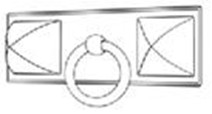
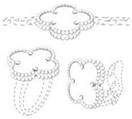
In the fashion industry, aside from traditional trade mark registration protection, what stands out is protection for three-dimensional marks that are distinctive enough to constitute a badge of origin. Examples depicted below include Hermès International’s registration in the UAE under Mark No. 212332 in class 25, including Richemont International S.A.’s well-known Van Cleef & Arpels Alhambra motif jewellery design, registered in the UAE under Mark No. 179530 in class 14.
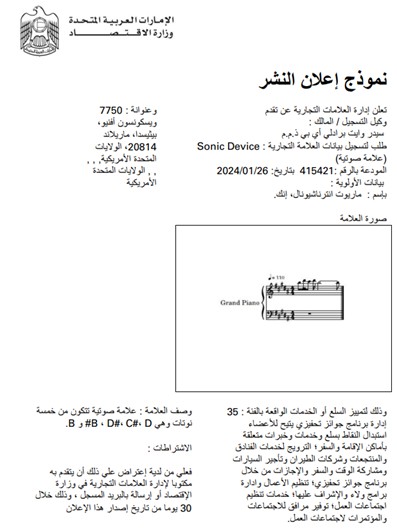
Significantly, in 2024, CWB filed the first sound trade mark application in the UAE, which has since registered a milestone in the UAE in the global trend towards recognising and protecting non-traditional marks. The filing was for a large international hospitality company, prepared in close collaboration with officials at the Ministry of Economy & Tourism, and sound trade mark registration practices from various countries around the world were closely considered regarding international best practices. Below is a publicly available extract of the trade mark as published. As can be seen, a helpful description is included that the trade mark is a sound that consists of five notes.
Trade mark registration is crucial in the fashion industry, as it provides an owner with exclusive rights to use a trade mark and take legal action against infringers. It is also a pre-requisite for customs registration in the UAE. Further, while the Trade Mark Law provides for oppositions based on unregistered well-known trade marks, as an example, formal registration is the primary method for securing rights.
Additionally, over the last few years the UAE has increasingly introduced “Made in” regulation, examples including the Emirates Quality Mark, and the Made in the Emirates mark and associated initiative, aiming to enhance the competitiveness of Emirati products in both local and international markets. Mark depictions are below.

The Make it in the Emirates initiative was launched in 2021 to attract and encourage the development and manufacture of products in the UAE. Additionally, in 2023, the Ministry of Industry and Advanced Technology published Cabinet Decision No. 16 of 2023, providing the circumstances under which a licence certificate could be issued for the use of the Made in the Emirates mark in relation to fully or semi-manufactured materials produced by industrial establishment in accordance with the requirements set out under the law.
Going back to the Trade Mark Law, geographical indications may also be registered. In May 2025, the Ministry of Economy & Tourism announced the launch of the geographical indications system for national products, the first-of-its-kind federal initiative designed to safeguard local products with unique features and characteristics that originate from specific geographical regions in the UAE. As a result, online applications for geographical indications in the UAE are available to both local and foreign applicants. As a fashion-adjacent example, we note that Ras Al Khaimah (RAK) Ceramics from the Emirate of Ras Al Khaimah forms part of the first batch of applications under the new system, paving the way for protection against misuse and safeguarding authentic local products.
Recent statistics and developments worth sharing:
- Trade mark registrations in the UAE continue to grow steadily, with the total number of national and international trade marks registered in the UAE having reached 34,234 for the period from January to early November 2025 alone.
- Significantly, during the first half of 2025, 19,957 national and international trade marks were registered in the UAE, a growth of 129% compared to the first half of 2024.
- During 2024, the number of national and international trade marks registered doubled, reaching 31,537 as compared to 16,712 in 2023.
- Interestingly, in November 2025, the Ministry of Economy & Tourism launched a trade mark platform, TM Market Place, the first digital platform of its kind in the UAE and in the region, for buying and trading trade marks. This new national project is yet another way in which the Ministry is ensuring an innovative and competitive landscape for intellectual property and trade marks in the UAE, ultimately strengthening appeal for global companies and brands, including those in the fashion industry.
In addition to the registration of non-traditional trade marks, discussed above, industrial design rights regulated by Federal Law No. 11 of 2021 (“Industrial Property Law”) are particularly useful to protect the aesthetic, non-functional aspects of products in the fashion industry, such as two-dimensional or three-dimensional ornamental features that give a special appearance to a product. This gives highly sought-after protection to visually unique items in the fashion industry, often covering the designs of shoes (for example, the clog design of Crocs Inc., depicted below).
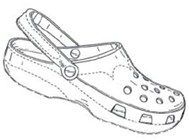
Design protection is a powerful addition to a trade mark. While a trade mark protects the name and logo on shoes, an industrial design can protect the unique shape and appearance of the shoe itself. To be eligible for protection in the UAE, a design must be new and original, meaning it has not been disclosed to the public before filing and creates a distinct visual impression. Registration grants the owner the exclusive right to prevent third parties from using the industrial design in the making of any product, including importing any product related to the industrial design, or possessing such product for the purposes of commercial use, offering it for sale or selling it.
Copyright protection in the UAE arises automatically upon the creation of an original work in a tangible form, without the need for registration, and is governed by Federal Decree Law No. 38 of 2021 (“Copyright Law”). In fashion, this often includes initial fashion sketches, patterns and embroidery designs, photographs such as lookbooks and other brand photography.
Copyright is an extremely important right to be aware of considering that it is free and automatic provided that certain requirements are met, such as originality. While protection is granted upon the creation of the work and does not require formal registration, doing so in the UAE is recommended as it assists owners with prima facie evidence of rights at the stage of enforcement. This is in addition to, for example, a fashion designer’s clear record keeping of original fashion sketches to support evidence of creation, if required in future.
While less common in fashion, patents are available for genuine inventions that are new, involve an inventive step, and are industrially applicable. Similarly to designs, patent protection is also regulated by the Industrial Property Law and could apply to “fashion tech” such as smart fabrics, wearable technology, or novel manufacturing processes.
As mentioned above, the UAE also has provisions for the registration and protection of geographical indications. As a sign used on products that have a specific geographical origin and possess qualities or a reputation that are a result of that origin, for fashion, this often applies to specific textiles or traditional crafts known to originate from a particular region.
In the UAE, the fashion industry relies on a variety of robust contractual arrangements to manage the lifecycle of a product, from creation to consumer. These agreements are governed by general principles of contract law alongside specific commercial laws, as discussed below.
Licence agreements
Licence agreements are crucial when a brand licenses its trade mark to a third-party manufacturer. Key clauses include the scope of the licence (trade marks, products, territory, duration), quality control provisions to protect brand reputation, royalty payment structures, and clear terms on the ownership of any new intellectual property created under the agreement, by way of example.
Non-disclosure agreements (NDAs)
NDAs are vital in the fashion industry in early stages of design and production to protect trade secrets like unique patterns and supplier lists. An effective NDA in the UAE must clearly define what constitutes confidential information, and specify the duration of the confidentiality obligation, which should continue even after the contract ends.
Subcontract agreements with suppliers/in-house manufacturing
Subcontract agreements with suppliers/in-house manufacturing often govern the production of fashion goods. Essential clauses include, for example, detailed product specifications, quality assurance and inspection protocols, delivery schedules, liability for defects, and clear terms on intellectual property ownership, ensuring that the manufacturer cannot use the brand’s designs for other clients.
Agency agreement
The regulation of commercial agencies in the UAE has undergone a significant transformation with the introduction of Federal Law No. 3 of 2022 (“Agency Law”), which came into effect in June 2023. The previous law was highly protective of UAE national agents, often making it difficult for foreign principals to terminate an agreement without the agent’s consent or paying substantial compensation. The new law, however, introduces more flexibility.
While an agent can still claim compensation for damages if a contract is terminated by a principal, for example, the grounds for termination now are broader. For instance, a contract can be terminated in the UAE upon the expiry of its term if proper notice is given. The notice period is one year before expiry, or half the contract’s term, whichever is less, unless otherwise agreed. For long-standing agency agreements, other rules apply.
Selective distribution online in high-end fashion and trade mark protection
Selective distribution systems, where suppliers agree to sell only to distributors selected on the basis of specific criteria (e.g. quality of retail space, staff training), are common for luxury fashion brands in order to maintain brand image and exclusivity, for example. These arrangements are generally permissible provided the agreements do not breach the UAE’s competition laws by fixing resale prices or creating an anti-competitive monopoly. While these arrangements helpfully aid to preserve trade mark value by preventing goods from being sold in unsuitable environments that could tarnish a brand’s luxury positioning, brand owners should ensure that these arrangements are dictated by selection criteria that are objective, qualitative, and applied non-discriminatorily.
Co-branding and co-marketing
Co-branding agreements, where two brands collaborate on a single product, are popular in the fashion industry. Key clauses in the UAE would regulate:
- Brand and royalty management. The contract must clearly define how each brand’s trade marks will be used, the ownership of the new co-branded product’s IP, and how revenue or royalties will be split.
- Reputational damage and brand co-existence. The agreement should include clauses allowing for termination if one party’s actions bring the other brand into disrepute. It should also outline mutual approval rights for all marketing and promotional materials to ensure brand messaging is consistent and protects the integrity of both parties.
Franchising and alternative sales model agreements
Franchising in the UAE is regulated generally under contract laws, and more specifically under the Agency Law, which requires registered franchise arrangements to be recorded at the Ministry of Economy & Tourism. Requirements for an agreement to be registered include that it must be in writing, notarised and translated into Arabic; and the franchisee should be a company with at least 51% owned by UAE nationals (or in the case of individuals, the franchisee should be a UAE national).
On the other hand, general contract laws apply to unregistered franchise arrangements, the most relevant being Federal Law No. 5 of 1985 amended by Federal Decree Law No. 30 of 2020 (“Civil Code Law”), including Federal Law No. 50 of 2022 (“Commercial Code Law”). These agreements tend to be more flexible and less restrictive than those to be registered under the Agency Law, which is why foreign companies tend to prefer unregistered agreements over registered ones.
For the fashion industry, it is helpful to know that while the franchisor is allowed to provide recommended retail prices, the recommendation should be non-binding and competition laws prohibit the franchisor setting a minimum price at which franchisees must sell products in certain circumstances.
Employing fashion models
Contracts with fashion models must include clear model release forms. Key clauses are the scope of use (which campaigns, media, territories, etc.), the duration of use, compensation, and a waiver of any future claims. The contract should also specify whether the model can work for competing brands during the term.
Social media, influencers and brand ambassadors/celebrities
The UAE has one of the most regulated environments for influencer marketing in the world. All paid influencers must obtain a licence from the relevant authorities, like the UAE Media Regulatory Office and the National Media Authority. Contracts with influencers are a legal necessity and must be robust. Key clauses include:
- Compliance. A warranty from the influencer that they hold valid licences.
- Exclusivity. Terms preventing the influencer from promoting competitor brands for a specified period.
- Disclosure. A mandatory requirement for the influencer to use clear and conspicuous disclosures like ‘#ad’ or ‘#sponsored’ on all paid content.
- IPRs. Clear terms on who owns the content created and how the brand can use or repurpose it.
- Content control. Clear guidelines on the brand’s messaging and values, and often a right for the brand to approve content before it is posted.
Failure to comply can lead to fines for both the influencer and the brand.
Advertising standards, relevant authorities and advertising practice
All advertising in the UAE is regulated by bodies like the UAE Media Regulatory Office and the National Media Authority, and is subject to the associated advertising standards. The overarching principles require all advertising to be truthful, honest, and not misleading. For fashion, this means advertisements must:
- Respect religious and cultural values, for instance, by being mindful of modesty in imagery.
- Not contain false or exaggerated claims.
- Be in Arabic, although other languages can be used alongside it.
- Not unlawfully use third-party trade marks.
Online marketing in the UAE is governed by several key pieces of legislation, including the below:
- Federal Decree Law No. 45 of 2021 on the Protection of Personal Data, the UAE’s primary data protection law which prohibits the processing of personal data and using it for marketing communications without the explicit consent of an individual;
- Federal Law No. 15 of 2020 (“Consumer Protection Law”), which prohibits misleading advertisement; and
- Federal Decree Law No. 46 of 2021, the Electronic Transactions and Trust Services Law which regulates the validity of electronic documents and boosts the legal value of digital signature and the level of its security in the UAE.
Enforcement is carried out by bodies such as the Ministry of Economy & Tourism by way of its Consumer Protection Department, including the Telecommunications and Digital Government Regulatory Authority that plays a crucial role in regulating the digital space in the UAE.
The primary law is the Consumer Protection Law. For fashion businesses, the most relevant rules include:
- Right to correct information. All product descriptions must be accurate. Misleading information about the material, origin, or quality of a fashion item is prohibited.
- Clear pricing. Prices must be clearly displayed.
- Data privacy. The law prohibits suppliers from using a consumer’s personal data for marketing purposes without their consent.
The concept of protecting a store’s layout falls under the legal principle of “trade dress”, which is a form of intellectual property that protects the visual appearance of a product or its packaging. In the UAE, protection for a unique and distinctive physical store layout could potentially be argued under a combination of laws:
- Unfair competition. If a competitor copies a store layout so closely that it is likely to confuse consumers, an action could be brought under unfair competition principles.
- Copyright. If the layout includes original artistic works, these individual elements could be protected by copyright.
- 3D trade mark. If the store’s layout is exceptionally unique and has acquired distinctiveness as an indicator of the brand, it might be possible to register it as a 3D trade mark.
Applying these protections to an online store layout is theoretically also possible. Reliance could, for example, be on the unique graphical user interface, including the arrangement of visual elements, colour schemes, and the overall “look and feel”, as copyright protected elements if sufficiently original.
For fashion businesses, unfair competition rules are critical for protecting goodwill and trade secrets. While unfair competition rules in the UAE are not consolidated into a single law but are found across laws, the core principle is prohibiting acts that are contrary to honest commercial practices.
Examples of unfair competition include acts that cause confusion with a competitor’s business or products, such as intentionally adopting an identical or similar trade mark as a competitor, imitating a brand’s trade dress or distinctive packaging. Misappropriation of trade secrets also constitute unfair competition in the UAE.
While the UAE provides robust protection for trade secrets, that protection is spread across several laws, for example:
- Federal Decree Law No. 31 of 2021, UAE’s Crimes and Penalties Law, criminalises the unauthorised disclosure of a secret by anyone entrusted with it through their profession, with penalties including imprisonment and fines.
- Federal Decree by Law No. 33 of 2021, regulating labour relations in the UAE, allows for the immediate dismissal of an employee who reveals company secrets.
- The Trade Mark Law, which prohibits the disclosure, use or publication of undisclosed information. The law also sets out the requirements for protection of trade secrets, namely that the information should be secret, have commercial value because it is secret and be subject to reasonable steps to be kept secret.
- DIFC Law No. 4 of 2019, which applies in the jurisdiction of the Dubai International Financial Centre (DIFC) in the UAE, and aligns largely with the Trade Mark Law, in terms of trade secret provisions, as it provides that the following acts, for example, shall constitute misappropriation of a trade secret and be prohibited under the law:
- the acquisition of a trade secret by improper means;
- the disclosure or use of a trade secret by a person who used improper means to acquire knowledge of the trade secret; and
- the acquisition, disclosure or use of a trade secret by a person who at the relevant time knows, or ought to have known, that the knowledge of the trade secret was derived or acquired through certain unlawful means.
- Federal Decree Law No. 32 of 2021, on the regulation of commercial companies, that provides sanctions for a person who uses or discloses company secrets or deliberately attempts to cause harm to a company.
To enforce trade secret rights, a fashion business must demonstrate that it took reasonable steps to keep information secret, e.g. through NDAs and internal security measures. Enforcement can be pursued through civil claims for damages or by filing a criminal complaint.
While the UAE does not have a single, comprehensive law specifically regulating sustainability or ESG in the fashion industry, there is a strong and growing framework of government initiatives, policies, and related laws that are driving the sector in this direction.
The UAE’s strategic goals, set by government initiatives, for example, set a clear direction for all industries, including fashion. For instance, the UAE Net Zero by 2050 initiative, aims to reach net zero by 2050 and focuses on expanding the utilisation of renewable energy sources in the UAE, while the UAE Green Agenda 2030, aims to make the UAE economy more environment-friendly and reduce the country’s emissions to less than 100 kilowatt-hours by 2030. Additionally, initiatives like the Dubai Fashion Sustainability Pact, enhances eco-friendly practices in the UAE’s fashion industry by encouraging local designers and international brands to use sustainable materials, recycle, and adopt transparent, ethical operations.
While not a specific law, an initiative like the Arab Fashion Council’s AFC GREEN LABEL directly promotes the observance of sustainability standards in the fashion industry. The aim of the AFC GREEN LABEL is to foster a responsible approach to the environment by advocating for ethical materials and adhering to the United Nations Sustainable Development Goals. Selected brands which meet the stringent criteria set by the AFC GREEN LABEL, can showcase their collections to a broad audience during Dubai Fashion Week while being fully sponsored by the Arab Fashion Council. The platform allows brands to display their creativity and innovation and promote a conscious choice for a more sustainable industry.
While there are no specific “greenwashing” rules, the Consumer Protection Law prohibits false or misleading claims, which would apply to unsubstantiated environmental claims, and the UAE Advertising Guide also requires claims to be truthful and not exaggerated.
Broadly speaking, environmental regulation in the UAE is regulated by Federal Law No. 24 of 1999 on the Protection and Development of the Environment that address various environmental issues such as environmental protection, resource management and pollution control, to name a few.
Finally, while no specific ISO certification is mandated in the UAE, companies often seek certifications like ISO 14001, covering environmental management systems, which helps companies decrease the impact on the environment by efficient resource utilisation, to demonstrate a commitment to sustainability and improve market credibility.
The UAE has a robust system for customs monitoring and intellectual property enforcement, which is particularly relevant for fashion products that are frequently targeted by counterfeiters. The effectiveness of this system is demonstrated by recent enforcement actions, such as in 2024, Dubai Customs reported the seizure of goods valued at approximately AED 92.695 million (approximately USD 25.25 million). These seizures specifically included a high volume of fashion-related counterfeit goods such as watches, eyewear, clothing, fabrics, bags, and shoes.
Brand owners with a registered UAE trade mark can record their rights with the customs departments across five Emirates: Abu Dhabi, Dubai, Sharjah, Ajman, and Ras Al Khaimah. The application typically requires:
- a copy of the valid trade mark registration certificate;
- a legalised Power of Attorney if a local representative is filing on the brand owner’s behalf; and
- information to help officials distinguish between genuine and counterfeit products.
Once accepted, the recordal is valid for the duration of the trade mark registration.
Customs recordal empowers authorities to proactively monitor and detain suspicious shipments. If a shipment is detained, customs will notify the brand owner or their legal representative, who then has a specific period to inspect the goods. Upon confirmation that the goods are counterfeit, the brand owner can file a formal complaint, leading to seizure and destruction, with costs borne by the brand owner. This process serves as a critical frontline defence stopping infringing goods at the border before entering the UAE market.
We want to protect our IP. Where do we start? We’re a fashion startup.
For a fashion business, start by registering your main trade marks in the UAE, which would typically include your brand name, logo(s) and slogans. Further secure your brand name by way of company name and domain name registration, and social media profile name creation, which helps to avoid registration of the exact company name, domain name and social media profile name by third parties. In addition to these core IP considerations, ensure that you have suitable agreements in place with all third parties, for example, employment agreements in place with employees, and copyright assignment agreements with any third party creating original copyright protected work for you, which should be signed by your logo and online fashion store designer and developer, to ensure that your startup owns the relevant copyright.
We want to collaborate with a popular fashion influencer in Dubai. What are the most critical legal requirements?
The two most critical requirements in the UAE are licensing and disclosure. First, you must verify that the influencer holds a valid licence, such as an e-media licence from the UAE Media Regulatory Office, and an advertising permit from the National Media Authority, both of which are lawfully required in order for them to conduct paid promotions, including unpaid advertisement via social media, for example. Your contract should contain a warranty confirming this. Second, the contract must explicitly require the influencer to clearly and conspicuously disclose that the content is a paid advertisement, using hashtags like ‘#ad’ or ‘#sponsored’ at the beginning of captions on social media posts, for example, to comply with UAE advertising standards. Failing to do so can result in fines for both your brand and the influencer.
A former employee has left to start a competing fashion brand and we suspect they have taken our confidential supplier lists and client database. What can we do?
The UAE legal framework offers strong protection for trade secrets. Under the UAE Labour Law, employees have a duty to safeguard their employer’s secrets, even after employment ends. Revealing such secrets is grounds for dismissal without notice and can lead to legal action. The success of a civil case will depend on your ability to prove the information was confidential and that you took reasonable steps to protect it (e.g. through employment contracts and NDAs).