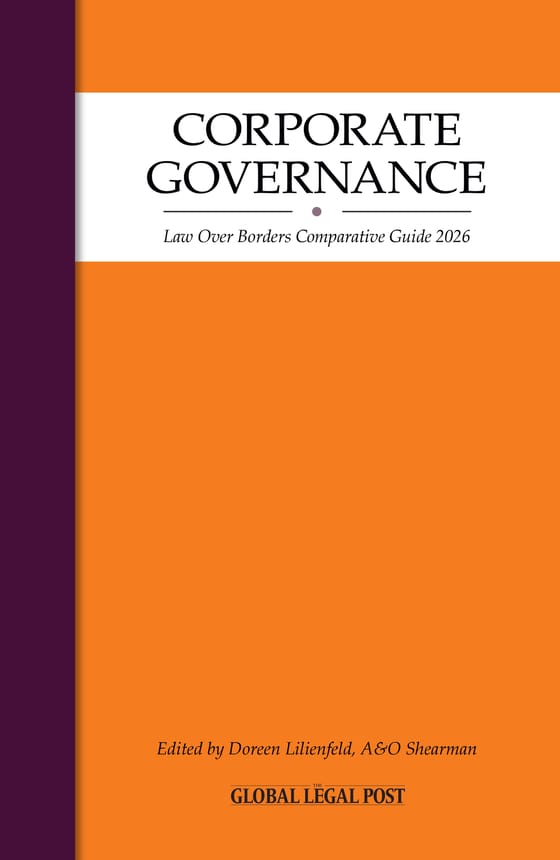
Corporate Governance Law Guide
Free worldwide delivery.
About the Practice Guide
Upcoming Event
Corporate Governance Roundtable on 01 Dec 2026. Learn more →
Editor

A&O Shearman is one of the leading law firms in Germany, with offices in Düsseldorf, Frankfurt am Main, Hamburg, and Munich, and approximately 250 lawyers, including around 60 partners. We combine global strength with local expertise to ensure our clients’ success. We support leading national and international companies and institutions in their growth and innovation processes and advise on all aspects of commercial and capital markets law, including on some of the most challenging and critical issues and sectors, such as energy transition, technological change, life sciences and private capital.
Read more →Jurisdictions






 ANG
Angola - Market Insights
Brazil
 BRA
Brazil - Market Insights
Canada
 CAN
Canada - Market Insights
Denmark
 DNK
Denmark - Market Insights
Ireland
 IRL
Ireland - Market Insights
Israel
 ISR
Israel - Market Insights
Japan
 JPN
Japan - Market Insights
Portugal
 PRT
Portugal - Market Insights
Venezuela
 VEN
Venezuela - Market Insights
Introduction
Editor's Introduction
Why corporate governance matters now
Corporate governance has never occupied a more prominent position in the commercial and regulatory landscape than it does today. The mechanisms by which companies are directed, controlled, and held accountable are no longer matters of interest solely to company secretaries and institutional investors. They sit at the center of debates about economic resilience, capital allocation, social responsib...
Why corporate governance matters now
Corporate governance has never occupied a more prominent position in the commercial and regulatory landscape than it does today. The mechanisms by which companies are directed, controlled, and held accountable are no longer matters of interest solely to company secretaries and institutional investors. They sit at the center of debates about economic resilience, capital allocation, social responsibility, geopolitical risk, and the trustworthiness of markets themselves. From boardrooms in London and New York to supervisory boards in Frankfurt and shareholder meetings in Tokyo, the fundamental question remains the same: for whose benefit is the corporation managed, and who decides?
Recent years have intensified these questions considerably. The post-pandemic period brought renewed scrutiny of board effectiveness and crisis governance. The rapid adoption of environmental, social, and governance considerations into investment mandates — followed by a sharp political backlash in certain jurisdictions — has revealed deep fault lines in how different legal systems conceptualize the purpose of the corporation. Rising geopolitical fragmentation, the weaponization of supply chains, expanded national security review of foreign investment, and the emergence of artificial intelligence as both a governance tool and a governance risk have added new layers of complexity. Corporate governance is no longer a stable, slow-moving discipline. It is dynamic, contested, and increasingly divergent across borders.
A landscape of divergence
One of the central insights of comparative corporate governance scholarship is that governance systems respond to different agency problems in structurally different ways. In jurisdictions with dispersed ownership, such as the United States and the United Kingdom, the primary concern has traditionally been the agency conflict between shareholders and managers. In jurisdictions with concentrated ownership — much of continental Europe, Latin America, and large parts of Asia — the dominant tension is between controlling and minority shareholders. These foundational differences produce different board structures (unitary versus two-tier), different enforcement mechanisms (litigation versus regulatory oversight), and different philosophies about what the corporation owes to parties beyond its shareholders.
These structural differences are not converging as quickly as some predicted. If anything, recent years have seen new points of divergence emerge. The European Union, through instruments such as the Corporate Sustainability Reporting Directive (CSRD) and the Corporate Sustainability Due Diligence Directive (CS3D), has embedded stakeholder-oriented obligations directly into hard law. The United Kingdom, post-Brexit, has pursued its own path; the revised UK Corporate Governance Code 2024 introduced enhanced expectations around board accountability and internal controls, while stopping short of the EU’s mandatory due diligence approach. The United States, meanwhile, has seen a backlash against ESG integration in certain states, ongoing litigation and legislative debate around the scope of fiduciary duties under Delaware law, and continued reliance on disclosure-based regulation and shareholder activism as the primary governance levers. In Asia-Pacific markets, stewardship codes have proliferated, but their effectiveness remains uneven, and family-controlled conglomerates continue to challenge assumptions imported from Anglo-American models.
These divergences are not merely academic. For practitioners advising multinational groups, for in-house counsel designing governance frameworks across jurisdictions, and for business leaders navigating cross-border transactions, the differences in how governance obligations are framed, enforced, and evolving present real operational risk and strategic opportunity.
Current trends and emerging pressures
Several developments deserve particular attention as they are reshaping governance expectations globally and are addressed throughout this guide.
Board composition and accountability
There is growing pressure — from regulators, institutional investors, and proxy advisors — for boards to demonstrate greater diversity, relevant expertise (particularly in technology, cybersecurity, and sustainability), and a willingness to engage in genuine strategic oversight rather than passive monitoring. The expectation that non-executive directors bring independence of mind, not merely structural independence, is increasingly tested through say-on-pay votes, contested elections, and activist campaigns.
Shareholder activism and stewardship
Activist shareholders continue to expand their geographic reach and tactical sophistication. What was once a predominantly US phenomenon now operates effectively in Europe, the UK, Japan, and Australia. At the same time, passive index investors — whose stewardship responsibilities were long questioned — are under increasing pressure to articulate and act on governance expectations, even as some retreat from collaborative ESG-related engagement initiatives.
Sustainability and the ESG divide
The integration of sustainability into governance is perhaps the area of greatest current divergence. The EU has moved aggressively toward mandatory sustainability reporting and supply chain due diligence. Other jurisdictions are more cautious or actively hostile. For companies operating across borders, the result is a patchwork of obligations and expectations that demands careful navigation. The question of whether directors owe duties to stakeholders beyond shareholders — and if so, how those duties are enforced — remains unresolved in most legal systems.
Executive remuneration
Pay remains one of the most politically sensitive and commercially significant governance issues. Binding and advisory say-on-pay votes operate differently across jurisdictions, and the linkage of remuneration to ESG metrics has introduced new complexity and, in some cases, controversy.
Technology, AI, and cybersecurity
Boards face mounting expectations to oversee cybersecurity risk, govern the deployment of artificial intelligence, and ensure that technology adoption aligns with legal and ethical obligations. Several jurisdictions have introduced or proposed director-level accountability for cybersecurity incidents, and the governance implications of AI decision-making are only beginning to be addressed by regulators and courts.
Geopolitical risk and sanctions
The expansion of sanctions regimes, export controls, and national security review of investments has created a new dimension of governance responsibility. Directors must now consider not only commercial and legal risk but also the geopolitical positioning of their enterprises; a shift that demands governance structures capable of rapid, informed decision-making under uncertainty.
About this guide
This book is designed as a comparative reference for legal professionals and business leaders who need to understand how corporate governance operates — in practice, not merely in theory — across the world’s major jurisdictions. It is structured around a common set of questions put to leading practitioners in each covered jurisdiction, enabling the reader to make direct, meaningful comparisons on topics including board structure and duties, shareholder rights and activism, disclosure and transparency, related-party transactions, controlling shareholder constraints, audit and internal controls, and executive remuneration.
The guide does not attempt to provide an exhaustive treatise on the corporate law of each jurisdiction. Nor is it a compliance manual. Its purpose is to illuminate the structural choices, policy orientations, and practical realities that define governance in each market, and to allow the reader to identify where regimes converge, where they diverge, and what those differences mean for cross-border practice. The questions were selected to reflect the issues that practitioners and boards most frequently confront in multi-jurisdictional governance work: how to constitute and run a board effectively, how to manage conflicts of interest, how to respond to activist shareholders, how to comply with increasingly demanding disclosure expectations, and how to govern through periods of crisis and uncertainty.
The comparative structure is deliberate. Corporate governance cannot be properly understood in isolation. A practitioner advising a European parent on the governance of its US subsidiary, or an institutional investor assessing governance risk across a global portfolio, needs more than jurisdiction-specific knowledge. They need a framework for comparison: an understanding of why systems differ, where those differences create risk or friction, and how governance standards are likely to evolve in response to common pressures.
A note on method and perspective
It would be tempting to suggest that global corporate governance is converging toward a single best-practice model. The evidence does not support this. While international standards — the G20/OECD Principles of Corporate Governance, the International Corporate Governance Network’s Global Governance Principles, and the various regional codes and stewardship frameworks — provide a common vocabulary, the implementation of that vocabulary differs profoundly depending on ownership structures, legal traditions, enforcement cultures, and political economy. A “comply or explain” code operates very differently in a market dominated by dispersed institutional shareholders than in one dominated by family groups or the state.
This guide takes the position that understanding these differences — rather than assuming convergence — is the more useful and intellectually honest approach. It is written for readers who need to operate effectively across systems, not for those seeking reassurance that one model will eventually prevail. The contributors to this volume are practitioners working at the intersection of law, business, and regulation in their respective jurisdictions. Their insights are practical, commercially grounded, and informed by the realities of advising boards, shareholders, and regulators in real time.
Corporate governance will continue to evolve, driven by technology, geopolitics, social expectations, and the unresolved tension between shareholder primacy and broader stakeholder accountability. This guide aims to equip its readers to navigate that evolution with clarity, informed judgment, and a genuinely comparative perspective.
The law in this edition is as stated in September 2026.
Contributors

A&L Goodbody LLP (ALG) is internationally recognised as one of Ireland’s leading corporate law firms, delivering a full range of legal services to its domestic and international clients. Since its...


A&O Shearman is one of the leading law firms in Germany, with offices in Düsseldorf, Frankfurt am Main, Hamburg, and Munich, and approximately 250 lawyers, including around 60 partners. We combine...




AVELLUM is a leading Ukrainian full-service law firm advising on the most sophisticated and intellectually demanding transactional, regulatory, and dispute-related matters. The firm is the trusted cou...


Anderson Mori & Tomotsune (AMT) is one of the largest full-service law firms in Japan, with more than 740 lawyers. It is headquartered in Tokyo with branch offices in Osaka and Nagoya, as wel...




The Angola Corporate Governance Association (ACGA) is a private, non-profit association established in 2019. Its mission is to mobilise Angolan citizens and businesses, as well as Angola’s internation...





Founded in 1989, Freitas Leite e Avvad is a premier Brazilian law firm with strategic offices in São Paulo and Rio de Janeiro. We deliver highly specialized legal solutions to domestic and internation...


Hannes Snellman is a leading Finnish business law firm, trusted by clients in matters of critical importance. With a team of 250 dedicated professionals, we combine deep legal expertise with a collabo...




Herzog Fox & Neeman is one of Israel’s leading law firms, with a long-standing reputation as a trusted adviser to international clients active in Israel and Israeli clients operating globally. Wit...

JSA Advocates & Solicitors is a leading national law firm in India comprising over 700 lawyers, including 177 partners, based in Ahmedabad, Bengaluru, Chennai, Gurugram, Hyderabad, Mumbai and New...


We are one of Denmark’s leading full-service law firms, with offices in Copenhagen, Aarhus and London and more than 580 employees, including around 400 lawyers. We build our work on close collaboratio...



McCarthy Tétrault is a leading Canadian law firm delivering strategic, innovative solutions to clients in Canada and around the world. With offices in Canada’s major commercial centers, New York City,...



In 1896, Juan Bautista Bance began a successful legal practice in Caracas, with an impressive list of clients and a wide network of relationships with the most recognized firms abroad. In 1945 the Ban...




Morais Leitão, Galvão Teles, Soares da Silva & Associados is an international law firm headquartered in Portugal, recognised for its expertise, innovation, and global outlook. With over 80 years o...



Leveraging the expertise of its attorneys, and with nearly 30 years of experience, SCP Yanogo Bobson law firm is able to serve a diverse clientele ranging from startups to state-owned enterprises...