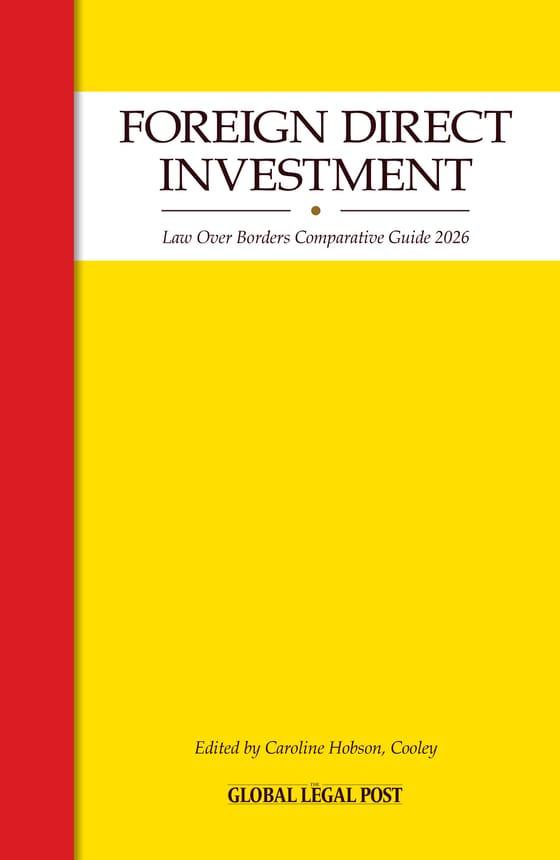
Foreign Direct Investment Law Guide
Free worldwide delivery.
About the Practice Guide
Upcoming Event
Foreign Direct Investment (FDI) Roundtable on 19 Nov 2026. Learn more →
Editor

Cooley has nearly 1,400 lawyers in 19 offices across the US, Europe and Asia. Cooley brings unmatched experience advising disruptive startups, unicorns, high-growth companies and major global players — offering pragmatic, market-savvy guidance. Cooley provides world-class counsel across the corporate life cycle, including private financings, cross-border M&A and capital markets, life sciences partnering, joint ventures, and general corporate matters and has deep experience of advising on merger control and foreign direct investment approvals. For further information, see www.cooley.com.
Read more →Jurisdictions
 AUT
Austria
Belgium
 BEL
Belgium
Canada
 CAN
Canada
Czech Republic
 CZE
Czech Republic
Denmark
 DNK
Denmark
Finland
 FIN
Finland
France
 FRA
France
Germany
 DEU
Germany
Hungary
 HUN
Hungary
Ireland
 IRL
Ireland
Italy
 ITA
Italy
The Netherlands
 NLD
Netherlands
Romania
 ROU
Romania
Spain
 ESP
Spain
Sweden
 SWE
Sweden
Switzerland
 CHE
Switzerland
Taiwan
 TWN
Taiwan
Turkey
 TUR
Türkiye
UK
 GBR
United Kingdom
US
 USA
United States

Introduction
Editor’s Introduction
A transformed regulatory landscape
Foreign direct investment (FDI) has been a key feature of globalisation and the growth of the global economy. For much of the late 20th century and into the early 21st, the policy consensus held that open capital markets were broadly beneficial — that the free movement of capital across borders generated wealth, transferred technology, deepened supply chains, and tightened bonds between states. In...
A transformed regulatory landscape
Foreign direct investment (FDI) has been a key feature of globalisation and the growth of the global economy. For much of the late 20th century and into the early 21st, the policy consensus held that open capital markets were broadly beneficial — that the free movement of capital across borders generated wealth, transferred technology, deepened supply chains, and tightened bonds between states.
Investment screening regimes existed in a number of jurisdictions, but they were the exception rather than the rule, often narrowly scoped, and rarely the first thing on a deal lawyer’s mind.
However, several factors have combined to transform the FDI landscape over the course of the past decade, leading to a proliferation of investment screening controls and increasing complexity for deal lawyers:
- A shifting geopolitical order. The geopolitical context in which cross-border investment takes place is changing rapidly and in ways that fundamentally alter how governments assess incoming capital. The post-Cold War era of relatively stable multilateral cooperation has given way to an environment defined by strategic competition between major powers, fragmented alliances, and renewed concerns about sovereign vulnerability. Increasingly, governments have become concerned about the security of critical infrastructure and supply chains, prompting them to reassess what it means for a foreign entity to exert influence over nationally significant assets. In this environment, the identity of an investor — including its ownership structure, its ultimate beneficial ownership, and any state connections — has become as scrutinised as the target itself.
- National security, economic security, and industrial strategy. Traditional FDI regimes were framed around national security in a relatively conventional sense — the protection of defence capabilities, critical infrastructure, and classified information. That framing has expanded substantially. Governments are now explicitly concerned with economic security and industrial security as distinct and co-equal objectives. Supply chain resilience, the retention of domestic capability in key industries, and the prevention of foreign dominance in sectors deemed essential to a nation’s long-term economic competitiveness are now openly cited as grounds for intervention. The scope of what constitutes a threat to national security has been interpreted broadly, and regulators have shown a willingness to act accordingly.
- Technological transformation and sensitive technology. A key factor driving the transformation of the FDI landscape has been the rapid pace of technological development and the strategic significance now attached to technological leadership. Artificial intelligence, semiconductor manufacturing, quantum computing, advanced biotechnology, and dual-use technologies more broadly have become the subject of intense governmental attention. Control over the development, production, and supply of key technology is understood by major powers as central to both economic and military advantage. This has given rise not only to tightened FDI screening in technology sectors but also to export control regimes, outbound investment restrictions, and whole-of-government approaches to technology that cross the boundaries of traditional regulatory disciplines.
As a result of these factors, the scope of FDI regimes has expanded markedly. Many jurisdictions that previously operated no formal screening mechanism have introduced one. Those that already had regimes have frequently broadened them — lowering equity thresholds, extending review to minority investments and certain asset acquisitions, widening the range of sectors subject to scrutiny, and introducing mechanisms to capture transactions that might otherwise fall beneath the notification threshold. The trajectory across jurisdictions is consistently in the direction of broader reach, not narrower.
One of the most significant practical shifts has been the move of FDI review from the periphery of a transaction to a central consideration. It is now commonplace for deal teams to assess FDI risk as an early-stage matter-of-course exercise rather than as an afterthought. Screening mechanisms that were once exercised infrequently and with limited scope are now invoked routinely, often with outcomes that determine whether a transaction proceeds at all. Filing obligations, review timelines, and the prospect of conditions or prohibitions are routinely factored into deal structures, timetables, conditions precedent, and regulatory risk allocation in transaction documents. Where FDI approval once featured rarely in merger control schedules, it now appears alongside merger control clearance as a standard fixture of cross-border M&A. The volume of formal filings, voluntary notifications, and government-initiated reviews has grown substantially year on year across multiple jurisdictions.
The landscape has therefore changed dramatically in recent years and today it is one that is almost unrecognisable from the one that prevailed even a decade ago. Understanding FDI controls is no longer a specialist concern for a handful of practitioners advising on defence-adjacent deals. It is a core competency for any lawyer, compliance professional, investor, or corporate finance adviser involved in cross-border transactions.
This guide is written for that audience. It is a practical guide to the current generation of FDI control regimes — how they work, where they apply, how they interact, and how to navigate them effectively.
The law in this edition is as stated in September 2026.
Contributors

ACTECON is recognised as one of Türkiye’s foremost competition law practices, known for combining the precision of legal analysis with the insight of economic expertise. For over two decades, ACTECON...



Accura is an ambitious corporate law firm consisting of attorneys and commercial experts translating the law into practice and providing clear recommendations for Danish and international businesses o...



Advokatfirman Delphi is a leading Swedish business law firm with around 150 lawyers across offices in Stockholm, Gothenburg, Malmö and Linköping. The firm advises Swedish and international clients acr...



August Debouzy is an independent, full-service French law firm with offices in Paris and Brussels. For more than 30 years, the firm has combined legal excellence with an entrepreneurial mindset to hel...


BLOMSTEIN is a leading European law firm specialising in international trade, government contracts, ESG, competition, and State aid. Based in Berlin and with offices in Brussels, Lisbon, and Düsseldor...



Binder Grösswang is one of Austria’s leading law firms. With over 60 years of experience and more than 100 lawyers, Binder Grösswang advises its national and international clients acros...



As one of Canada’s top business law firms, Blake, Cassels & Graydon (Blakes) provides exceptional legal services to leading businesses in Canada and around the world. We focus on building long-ter...




Bär & Karrer is a leading Swiss law firm with more than 210 lawyers in Zurich, Geneva, Lugano, Zug, Basel and St. Moritz. Our core business is advising our clients on innovative and complex transa...


With over 70 years in the industry and over 160 employees, Cederquist offers comprehensive expertise in all areas of business law. All our specialists work together under one roof, creating a sense of...



With more than 1,200 lawyers located in major financial centres around the world, Cleary Gottlieb is recognised as a leading international law firm. Cleary Gottlieb has been active in Italy since the...






Cooley has nearly 1,400 lawyers in 19 offices across the US, Europe and Asia. Cooley brings unmatched experience advising disruptive startups, unicorns, high-growth companies and major global players...



Filip & Company is one of the leading law firms in Romania, providing top-quality assistance in all relevant areas of law for businesses operating in Romania or considering Romania. Specialised in...




Gibson, Dunn & Crutcher is a leading global law firm, delivering unparalleled success for our clients around the world with 136 years of legal experience and expertise across borders, industries a...



Hannes Snellman is a leading Finnish business law firm, trusted by clients in matters of critical importance. With a team of 250 dedicated professionals, we combine deep legal expertise with a collabo...



Lee and Li is one of Taiwan’s largest and most respected law firms, with over 200 lawyers and numerous professionals, including accountants and patent attorneys. Renowned for expertise across diverse...



Liedekerke’s FDI Team is composed of screening experts with solid experience, including Anne Bonet, the first former ISC’s president. As the founding president of the ISC, Anne played a decisive role...



Loyens & Loeff is a leading independent European law and tax firm, widely recognised for its top-tier competition and regulatory practice. The firm advises on complex merger control, antitrust inv...




Established in 1825 in Dublin, Ireland and with offices in Cork, London, New York, Palo Alto and San Francisco, over 930 people work across Matheson’s six offices, including 128 partners and tax princ...





POELLATH is a leading German law firm with an international reach, specialising in business and tax law. With over 180 legal and tax professionals in Berlin, Frankfurt and Munich, POELLATH provides hi...



Pérez-Llorca is an Ibero-American law firm providing high-end legal advice on complex transactions, disputes and regulatory matters. With offices in Abu Dhabi, Barcelona, Bogotá, Brussels, Lima, Lisbo...



Founded in Austria in 1950, Schoenherr is a leading full-service law firm with a strong footprint across Central Eastern Europe. The firm operates 16 offices in 15 countries, with over 450 lawyers com...